Chapter 3 — full chapter
3.3 Textile Product Anatomy
An exploded garment diagram is a useful teaching tool because it makes every hidden component visible at once. Taking an office evening dress and a tailored jacket as examples, the same eight-part anatomy applies to almost any garment: fibres and yarns, fabric, interlinings, linings, closures, threads, trims and accessories, and labels and care labels.
Each of these components carries its own circularity impact: material choice, whether it is mono- or multi-material, how easily it can be disassembled, whether it is repairable and recyclable, and what realistically happens to it at end-of-life.
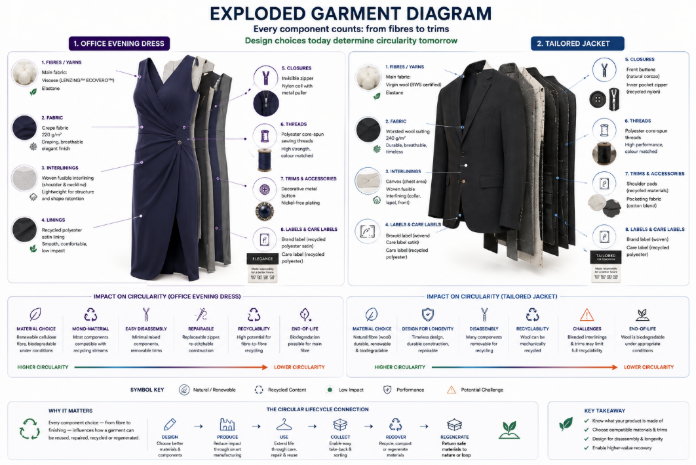
Figure 3.1. Exploded garment diagram — the eight-part anatomy of a textile product (fibres, fabric, interlinings, linings, closures, threads, trims, labels). Credit: FashionKIC, Exploded Garment Diagram, 2026.
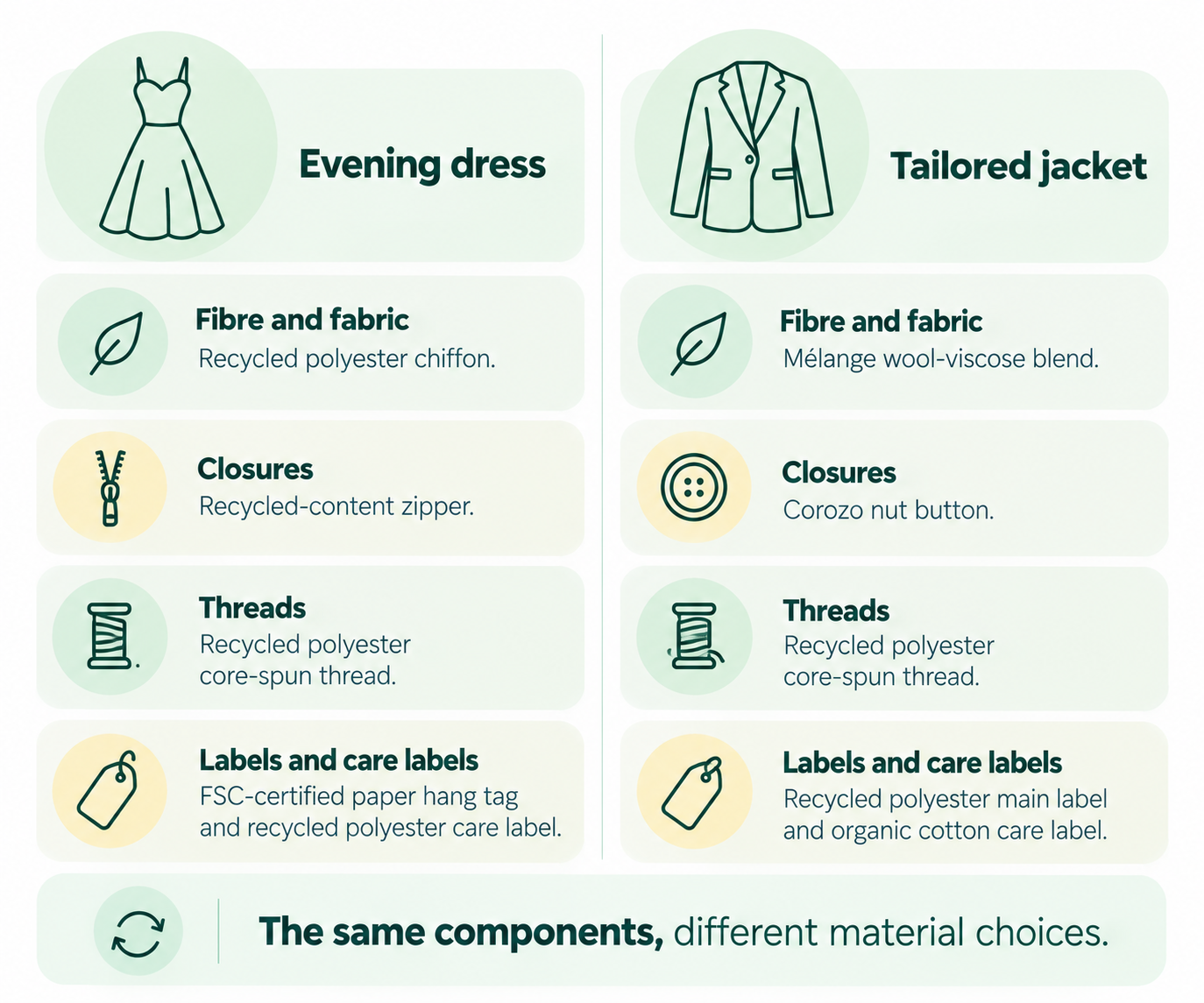
Each component carries its own circularity impact, and the choices made at the design stage decide which recovery options stay open later:
- Reuse and repair depend on durable materials and easy access for repair.
- Refurbishment depends on modular design.
- Recycling depends on mono-materials and compatible components.
- Biological recovery is only realistic for genuinely biodegradable materials.
- Energy recovery remains the last, lowest-value option, used only when nothing else is possible.
In short: circularity is designed in from the first material choice, not added on at end-of-life.
Looking at a garment component by component turns circularity into a product-level question: what is each part made from, what function does it perform, how is it attached, and what happens to it later?
This chapter focuses on identifying and evaluating those materials and components. Chapter 4 builds on this analysis by exploring how product architecture can be redesigned for durability, repair, disassembly and recovery, while Chapter 6 examines the recovery routes available after use.
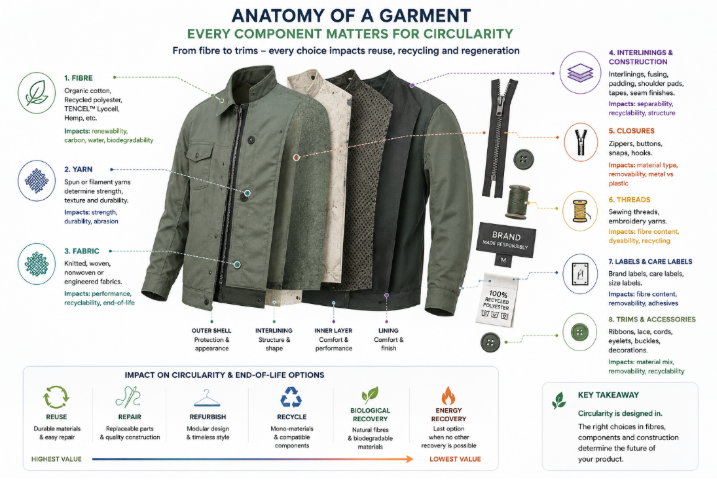
Figure 3.2. Garment component groups from fibre to trims and their effect on separability, recyclability and recovery. Credit: FashionKIC, Garment Component Groups Diagram, 2026.