Chapter 1 — full chapter
1.5 Key environmental, social and economic challenges
The textile and fashion industry faces interconnected environmental, social and economic challenges throughout the product life cycle, from raw material extraction to end-of-life management. These challenges should not be treated as separate problems because improvement in one area may create impacts elsewhere. For this reason, circular textile decisions need to be supported by life-cycle thinking, reliable information and an understanding of trade-offs. The following sections explore these challenges across the textile value chain, focusing on climate impact, life-cycle emission hotspots, water use and pollution, chemicals, resource use, biodiversity, labour conditions, transparency, waste, energy, animal welfare and the trade-offs that connect them (Figure 1.6).
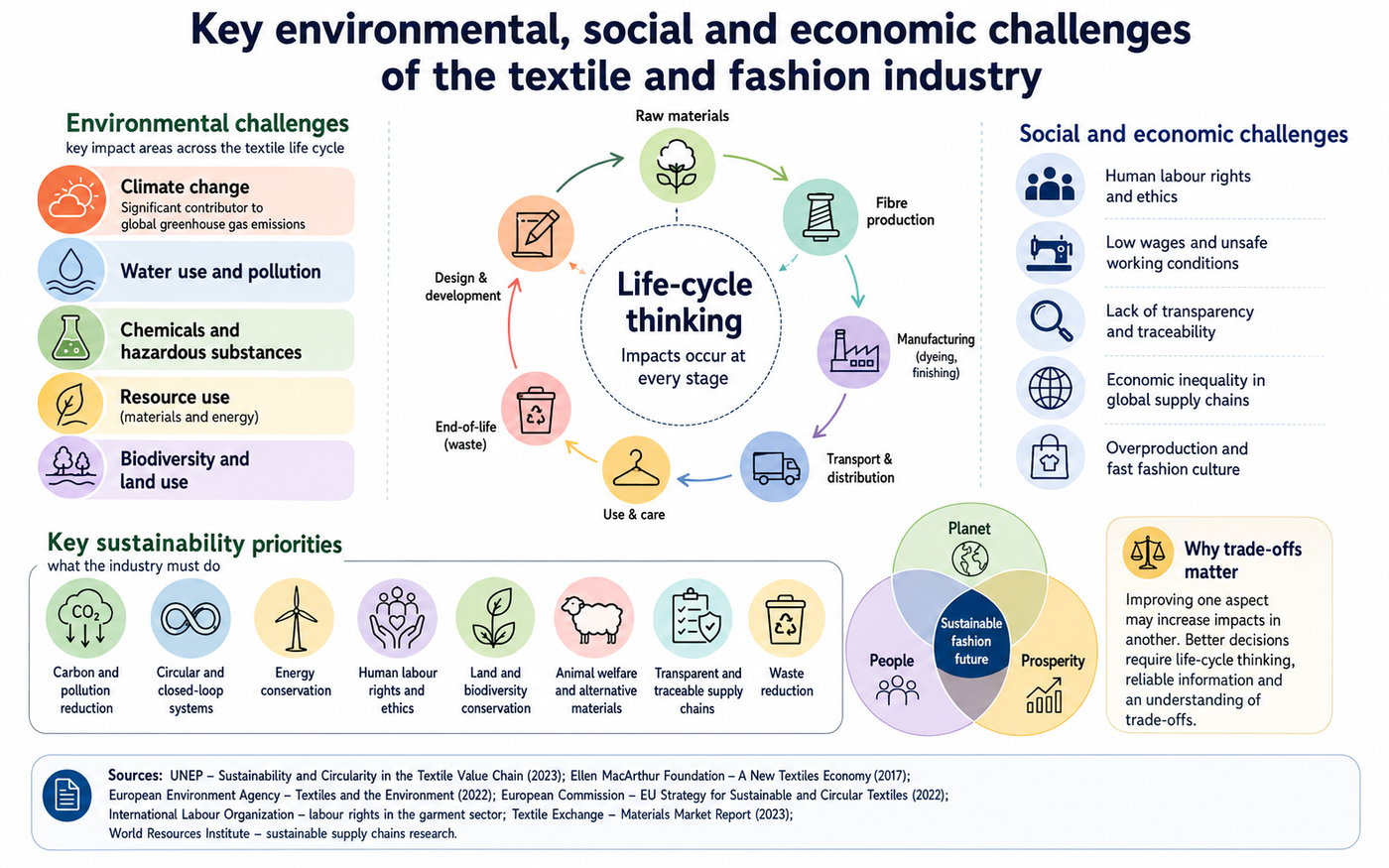
Figure 1.6. Overview of key environmental, social and economic challenges in the textile and fashion industry. Credit: FashionKIC, Challenges Overview Diagram, 2026.
1.5.1 Climate impact and carbon footprint
Climate impact is one of the main environmental challenges in textile and garment systems. Estimates vary according to methodology, sector scope and system boundaries, but the apparel and footwear industries are frequently estimated to generate around 8-10% of global carbon emissions, while one overview also reports approximately 1.2 billion tonnes of CO2 equivalent linked to textile industry emissions (Leal Filho et al., 2022). These figures should be treated as indicative rather than fixed, because results depend on what is included, for example fibre production, textile processing, garment manufacturing, transport, retail, use and end-of-life.
Product-level carbon footprints also vary significantly. A recent life-cycle study of five cotton garment types in China reported values ranging from 2.42 kg CO2e for childrenswear to 38.64 kg CO2e for fatigues, with T-shirts at 9.18 kg CO2e and workwear at 20.25 kg CO2e (Wang et al., 2025). These differences show why it is risky to use a single carbon figure for “a garment” without specifying the product type, material, production context, energy mix, transport assumptions, number of wears and care practices.
1.5.2 Life-cycle emission hotspots
Emissions occur across the full textile value chain. Fibre production, yarn production, fabric manufacturing, dyeing, finishing and garment manufacturing can be highly energy intensive, particularly when electricity and heat are generated from fossil fuels. Transport and distribution also matter because clothing supply chains are often international: the Carbon Trust notes that a large share of emissions embodied in clothing crosses borders between production and consumption regions (Carbon Trust, 2011). The use phase can also be significant, especially when products are washed frequently, tumble-dried, ironed or dry-cleaned. In a cotton T-shirt example, the Carbon Trust estimated around 15 kg CO2 over the product lifetime, with around half or more linked to use-phase activities under the assumptions used in the study (Carbon Trust, 2011).
This means that carbon reduction strategies should address the whole system. They may include selecting lower-impact fibres, reducing overproduction, improving durability, using renewable energy, increasing energy efficiency in spinning, weaving, knitting, dyeing and finishing, designing for longer use, encouraging lower-impact care, and planning realistic reuse, repair and recovery routes.
1.5.3 Water use, chemicals and pollution
Water use and pollution are major concerns across fibre cultivation, dyeing, printing and finishing. The European Parliament reports that textile production is estimated to be responsible for about 20% of global clean water pollution, mainly from dyeing processes (European Parliament, 2025). Safer chemistry, wastewater treatment, lower-impact colouration and careful finishing choices are important because dyes, coatings and chemical treatments can affect both environmental performance and future recovery options.
1.5.4 Resource use, biodiversity and land impacts
Textiles rely on land, water, energy, fossil resources, forests, agricultural systems and animal-based materials. Natural, synthetic, recycled and bio-based materials all have different impacts and constraints. A natural fibre is not automatically low impact, and a recycled fibre is not automatically circular if the product is not durable, repairable or recoverable.
1.5.5 Labour rights and working conditions
Circularity also has a social dimension. Textile supply chains can involve low wages, unsafe working conditions, excessive overtime and limited labour rights. A circular transition should therefore consider not only material flows, but also the people and organisations involved in producing, repairing, collecting, sorting and recovering textile products.
1.5.6 Transparency, traceability and accountability
Greater transparency and traceability are needed to support responsible sourcing, credible claims and better recovery decisions. Without reliable product information, it is difficult for customers, repairers, sorters, recyclers or regulators to know what a product is made of, how it was produced and which recovery route is realistic.
1.5.7 Trade-offs and life-cycle thinking
No single material or process solves all sustainability challenges. A material may reduce fossil-based content but increase land or water impacts. A durable synthetic product may last longer but be harder to recycle. A compostable material may only be suitable for biological recovery if the full product, including dyes, finishes, threads and trims, has been designed for that route. Life-cycle thinking helps learners recognise these trade-offs and make more balanced decisions.