Chapter 5 — full chapter
5.4 AI/ML for Sustainability Reporting
Sustainability disclosure used to be written by a communications team and read as a narrative. Under the CSRD and the ESPR it is a filing: structured, product-level, auditable, and produced on a schedule. A brand with tens of thousands of SKUs cannot assemble that by hand, which is why the same data infrastructure built for forecasting and sourcing is now pointed at accountability, matching bills of material to emission factors, filling gaps, and computing footprints per product rather than per company.
This section covers how those pipelines are built and where they break. Automation makes measurement continuous and cheap enough to publish, but it does not make it true: a footprint inherits the quality of its inputs, and an estimate presented with the confidence of a measurement is the shortest path from a reporting obligation to a greenwashing claim.
5.4.1 From Data to Disclosure: Machine Learning for KPIs and Reporting
Regulation is turning sustainability from a marketing narrative into a reporting obligation: the Corporate Sustainability Reporting Directive (CSRD), the ESPR and its Digital Product Passport all demand structured, auditable, product-level environmental data. Producing that data by hand is infeasible at catalog scale, so machine learning is increasingly used to automate it, matching bill-of-materials and supplier data to emission-factor databases, estimating missing values, computing footprints and KPIs per SKU, and feeding dashboards and regulatory filings. This is the data-and-ML complement to the life-cycle assessment methodology of Chapter 6: LCA defines what to measure and how, while these pipelines make the measurement continuous, comparable, and cheap enough to publish. The central risk is data quality, a footprint is only as credible as its inputs and factors, which is why defensible reporting depends on transparent methods and traceable primary data rather than convenient estimates, and why weak data is the fastest route to a greenwashing claim.
5.4.2 Case example: Carbonfact and Vaayu, product-level environmental data at scale
Paris-based Carbonfact provides carbon-management and environmental-data software that lets apparel, luxury and footwear brands measure, report and reduce emissions and comply with regulation; by 2026 it served more than 200 brands. In 2026 it acquired Berlin-based Vaayu, an AI-powered product-impact platform founded by a former Zalando sustainability executive, to build what the merged company calls fashion's largest environmental dataset: over 150,000 fashion-specific emission factors, 650+ material categories and data from thousands of textile factories, aimed squarely at CSRD, ESPR and Digital Product Passport requirements. The case shows the reporting pipeline in practice: machine learning turns fragmented supply-chain data into product-level footprints defensible enough to disclose (Carbonfact; ESG Today, 2026).
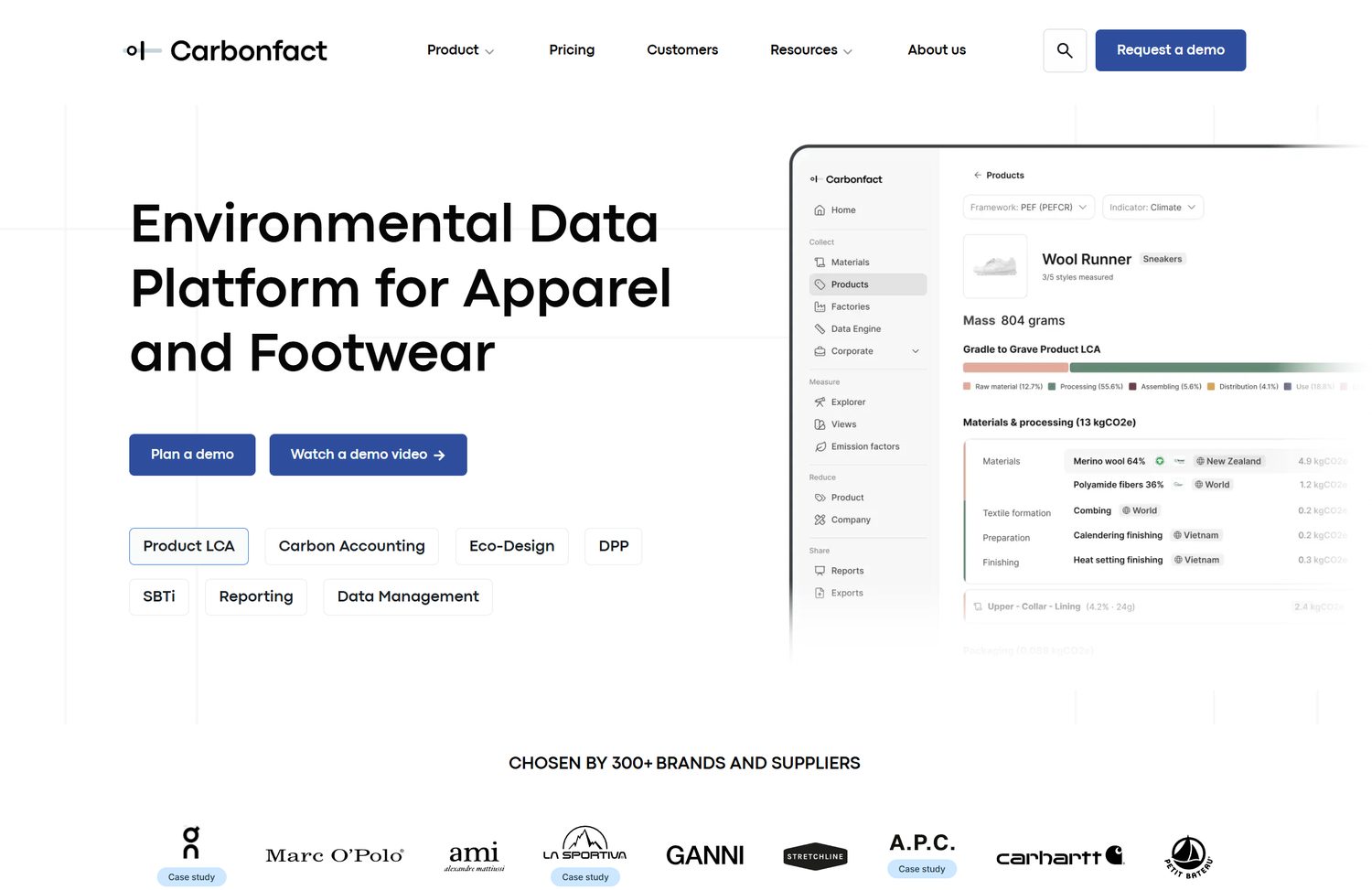
Figure 5.4, Carbonfact's environmental-data platform: a cradle-to-grave product LCA (here a wool sneaker) with impact broken down by material and stage. (Source: carbonfact.com)