Chapter 2 — full chapter
2.3 Generative AI for Design: Prompt Engineering and AI-to-3D
Generative models change the economics of the front end of design. A concept that once cost hours of drawing or modeling now costs a sentence, and the binding constraint shifts from producing options to evaluating them. This section covers both halves of that shift: prompting, where written intent becomes a visual proposal, and AI-to-3D, where an image becomes geometry that can be measured and, in some product categories, manufactured. The critical question throughout is not whether the output looks convincing but whether it holds up as a product proposal. Visual plausibility is cheap in these systems; verification is not.
2.3.1 Prompting as a Design Skill: Generative AI
Generative AI has become part of early-stage design practice: it accelerates ideation, expands the visual search space, and makes trade-offs visible at the concept stage. This section covers how the tools work, how prompt engineering functions as a design skill, and how to evaluate AI output critically against material feasibility and circular design principles.
Most contemporary tools rely on diffusion-based image generation models trained on large datasets of images and text. Designers interact with them through prompts that describe form, materials, proportions, use context, and stylistic references, prompts are not neutral descriptions but structured expressions of intent, and prompt engineering is therefore a design skill in itself, shaping how abstract intentions are translated into visual proposals.
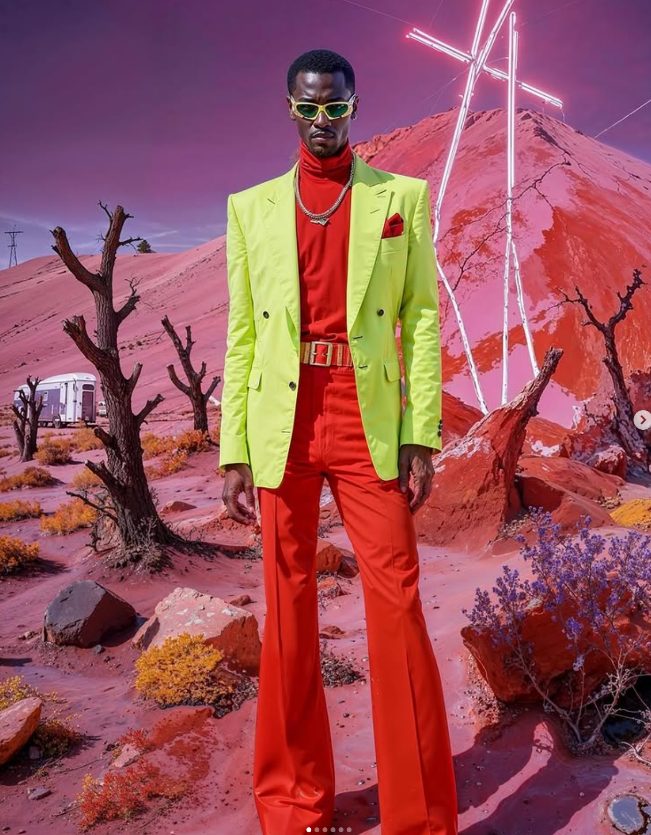
Figure 2.6, Example of AI-generated figurines (https://www.instagram.com/neural.waves/)
Because the generative-AI landscape changes so quickly, any list of tools is necessarily non-exhaustive and dates fast: the systems below are a representative snapshot, meant to show the range of approaches rather than to rank products or capture every option.
Stable Diffusion [49] _ https://stability.ai/
Stable Diffusion is an open-source image generation model widely used in creative, academic, and experimental contexts. Unlike closed commercial platforms, it can be accessed for free through community-driven web interfaces such as Hugging Face Spaces or installed and run locally on a personal computer. This openness allows users to control datasets, parameters, and workflows, making Stable Diffusion particularly relevant for research, education, and domain-specific experimentation that requires transparency and adaptability.
Midjourney [32] _ https://www.midjourney.com/
Midjourney is a diffusion-based image generation platform known for its strong visual coherence and high aesthetic quality. It prioritizes expressive imagery, stylistic exploration, and atmospheric depth, often producing results that function more as visual statements than literal representations. This makes it especially effective for exploring visual languages, moods, and speculative directions during early concept development.
OpenAI GPT Image [50] _ https://openai.com/index/introducing-4o-image-generation/
OpenAI's image generation, now delivered natively through GPT-4o and the GPT Image models rather than the standalone DALL·E app, emphasises semantic alignment between prompt and output, producing clearly defined objects and readable compositions with strong fidelity to the written description. This makes it well suited to communicating a specific, literal concept, and it integrates directly into ChatGPT's conversational workflow.
Ideogram [25] _ https://ideogram.ai/
Ideogram is a generative AI platform distinguished by its ability to accurately render text, typography, and graphic layout within images. Unlike most image generation models, which struggle with textual elements, Ideogram supports compositions that integrate words, symbols, and visual structure. This positions it as a useful tool for concept development involving branding, graphic systems, or visual communication, alongside imagery.
Adobe Firefly [18] _ https://www.adobe.com/sensei/generative-ai/firefly.html
Adobe Firefly is Adobe’s generative AI platform, developed to integrate seamlessly into professional creative workflows. Rather than focusing on radical or speculative generation, Firefly supports refinement, consistency, and controlled variation within established design environments. Its positioning emphasizes production-ready visuals and compatibility with existing creative tools.
Krea [30] _ https://www.krea.ai/
Krea is a generative AI platform characterized by real-time interaction and continuous visual feedback. Instead of producing images in discrete steps, it allows users to steer and adjust outputs dynamically during generation. This real-time quality makes Krea particularly suited to rapid ideation sessions where exploration and iteration happen fluidly rather than sequentially.
FloraFauna [19] _ https://app.florafauna.ai/
FloraFauna operates as an intelligent creative canvas that combines generative AI with compositional and organizational tools. Instead of functioning as a single-output generator, it supports the assembly, recombination, and evolution of visual ideas within a shared workspace. This approach encourages iterative concept building and visual reasoning across multiple stages of development.
FLUX.2 (Black Forest Labs) [55] _ https://blackforestlabs.ai
FLUX, developed by Black Forest Labs, the team behind the original Stable Diffusion, is a family of open and commercial models that by 2026 set the benchmark for photorealistic generation and precise prompt adherence. Available both as downloadable open weights and as a hosted API, it has become the default high-quality open alternative to closed platforms, favoured where realistic materials, lighting and product-like renders matter.
Recraft [52] _ https://www.recraft.ai
Recraft is a generative platform built for design deliverables rather than one-off images: it produces vector art, icons, mockups and packaging concepts, holds a consistent brand style across a set, and exports assets that scale to print and digital without rework, well suited to the graphic and product-communication side of a fashion collection.
Vizcom [53] _ https://www.vizcom.com
Vizcom is a design-focused tool aimed at product, footwear and apparel designers rather than at open-ended image generation. It turns a hand-drawn sketch into a full-fidelity render in seconds, keeps brand-accurate colors and materials from sketch to output, and lets designers explore form and material variations by prompt, recently extending from 2D rendering into sketch-to-3D. Its value in a sustainable-design workflow lies in control: it augments the designer's own drawing rather than replacing it, keeping human intent and manufacturability central.
Try it now
Use any of the tools mentioned above to generate three concept images of one garment with a structured prompt (form + material + context + style). Write down one thing the tool got wrong about construction, that observation is the “reading between the pixels” skill this section teaches.
- TIP: A designer with prompting skills produces usable concepts in hours instead of weeks of sketching; the IP position of AI outputs is still evolving, document your prompt workflow now
2.3.2 From Prompt to Prototype: AI-to-3D Generation
The frontier of this landscape is AI-to-3D: turning a text prompt or a generated image directly into a three-dimensional model. Two families of methods dominate. Multi-view reconstruction generates several consistent views of an object and fuses them into geometry, while native 3D-diffusion models synthesize shape directly; both then output either a polygon mesh or a Gaussian-splatting representation that is converted to a mesh, textured with physically based (PBR) maps and, in the better tools, automatically retopologised into clean quad geometry. What used to take hours of manual modelling now takes seconds to minutes.
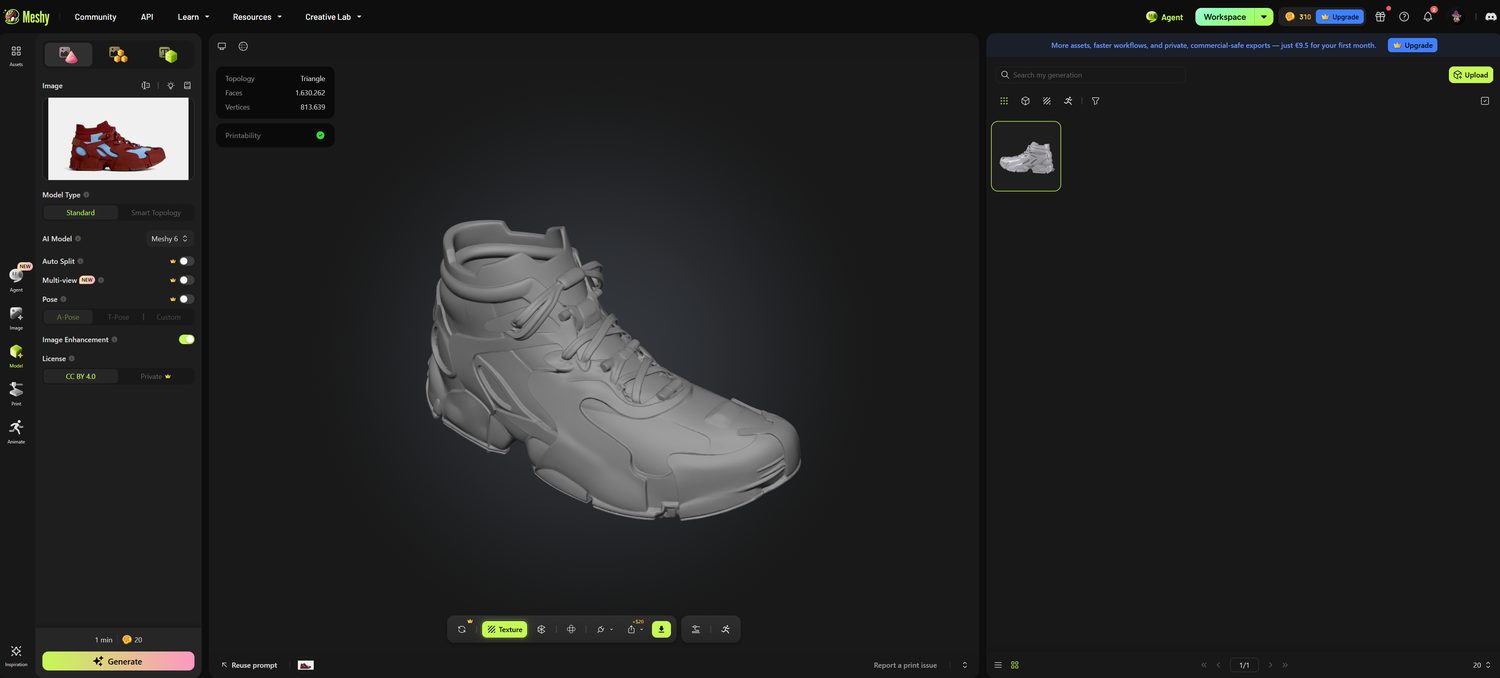
Figure 2.7, Meshy interface
The 2025–2026 tool landscape is moving fast. Commercial platforms such as Meshy, Tripo, and Hyper3D's Rodin lead on usability: Meshy emphasizes watertight, print-ready meshes with direct STL export and PBR texturing; Tripo adds near-instant quad retopology; Rodin targets highly realistic assets. Open-source models, Microsoft's TRELLIS and Tencent's Hunyuan3D, now rival them on visual quality but demand substantial GPU hardware, while earlier services such as Kaedim and Luma AI's Genie pioneered image-to-3D for game and product studios. For a design engineer, what matters is less the brand than the output class: a fast volumetric draft, not production geometry.
For fashion, the technology is unevenly useful. It performs best on hard, structured goods, footwear, eyewear, jewelry, hardware, accessories, where a solid mesh can be cleaned up, scaled and sent to additive manufacturing (Chapter 4); it is far weaker on soft, draping garments, whose behavior still belongs to the physics-based simulation of digital fabrics (Chapter 3) rather than to a static generated mesh. The pipeline emerging in footwear and accessory studios is therefore hybrid: AI image generation to explore the concept space, AI-to-3D for a fast volumetric draft, and parametric remodeling for the version that will actually be manufactured, because dimensions, wall thicknesses, and construction logic must still be rebuilt deliberately.
In a sustainable design workflow, an AI-generated concept should be read as a hypothesis about a product system: Is the object monomaterial or multi-material? Are components replaceable? Is the structure integrated or layered? Visual plausibility often masks technical, material, or sustainability inconsistencies, so outputs must be evaluated against material feasibility, construction logic, and circular design principles. Prompts can explicitly explore modularity, visible mechanical joints, disassembly, repair scenarios, and material narratives based on bio-based or recycled inputs; the designer's task is to negotiate trade-offs and articulate a defensible design position. Design judgment, not automation, remains central, and the emerging AI-to-3D pipeline, in which generated concepts inform parametric models and printable geometry, closes the loop in section 2.2.
2.3.3 Case example: G-Star RAW, the AI Denim Cape
In March 2023 the Dutch denim brand G-Star RAW[20] presented its first AI-designed denim collection: twelve concept pieces generated with Midjourney, of which one, a couture denim cape, was selected and physically produced by the brand's Amsterdam atelier. The design team worked from a documented prompt[43] (“denim cape morphic, model is wearing, organic shapes, minimal, futuristic hardware, techwear fashion”), iterated the generations, and then confronted the hard part: translating a photorealistic but structurally illogical image into a wearable garment. Deconstructing how the AI-imagined layers connected, where seams began and ended, took the atelier longer than the generation itself, and yielded construction solutions the team described as something “you would never design as a human”.
The case demonstrates how Generative AI expands the concept space upstream; the prompt itself is a design act; and human judgment, pattern-making knowledge, material understanding, manufacturability, remains the bridge from generated image to physical product, the same ‘reading between the pixels’ discipline developed in the didactic case above. Its limits are equally instructive: the cape is a single hand-made display piece, upstream of any sustainability claim, AI exploration can reduce material experimentation, but only production discipline turns concepts into responsible products. (G-Star RAW, 2023; Sourcing Journal, 2023; WWD, 2023.)
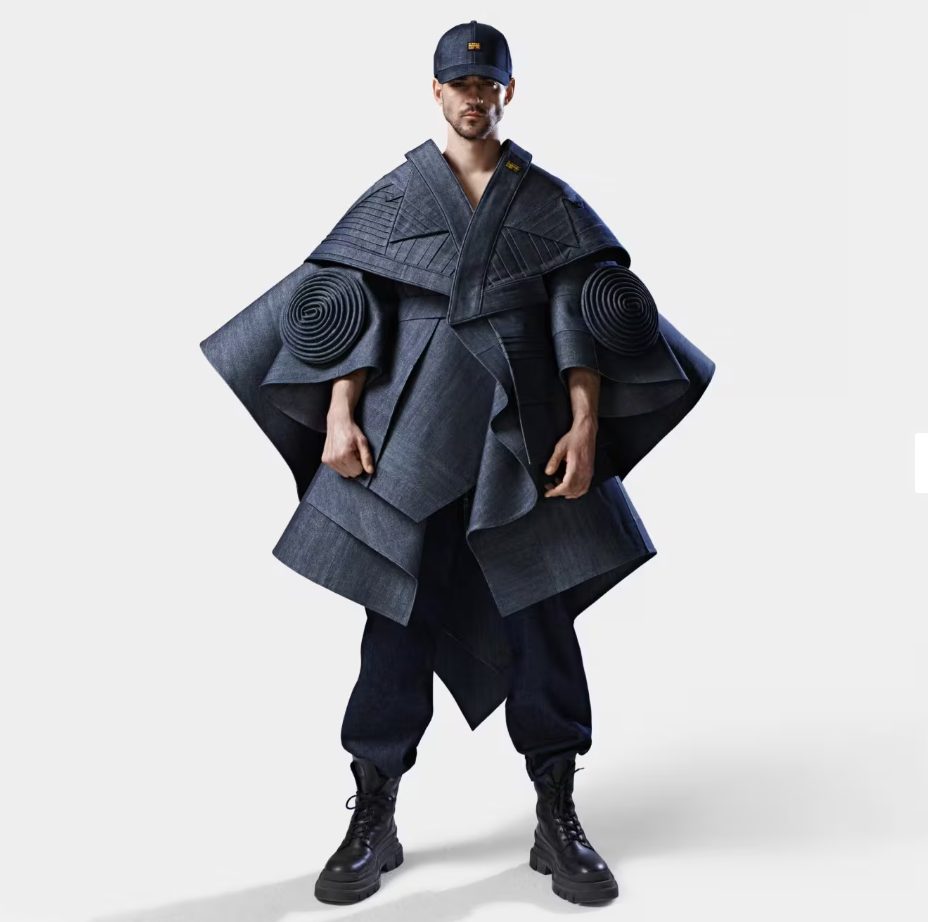
Figure 2.8, G-Star RAW's AI Denim Cape: a couture denim piece designed with Midjourney and produced in G-Star's Amsterdam atelier (2023). (Source: g-star.com)
2.3.4 Case example: Nike A.I.R. (Athlete Imagined Revolution)
Unveiled at the Palais Brongniart in Paris in April 2024, ahead of the Olympic Games, Nike’s A.I.R. project is currently the most complete industrial demonstration of the AI-to-3D pipeline described in this section. Working with 13 elite athletes across track, football, basketball, and tennis, from Eliud Kipchoge and Faith Kipyegon to Kylian Mbappé and Victor Wembanyama, Nike’s innovation team used large-language-model prompts and generative image models to translate structured athlete interviews (inspirations, aesthetics, performance needs) into hundreds of concept visuals per athlete. Critically, the AI outputs were treated as structured mood boards rather than final designs: designers returned to manual sketching for the technical specification, iterating drawings back and forth with the athletes, the same ‘reading between the pixels’ discipline developed in the didactic case above.
The selected concepts then crossed into 3D: computational designers rebuilt the 2D visuals as parametric models, the workflow of section 2.2, and produced physical prototypes on rapid 3D printers at Nike’s Concept Creation Center in Oregon, moving from generated image to wearable prototype in hours to days rather than months. The project also carries an explicit circularity dimension: several prototypes feature disassembled components and replaceable cork insoles designed to extend product life. A.I.R. condenses the entire arc of this chapter, generative AI to expand the concept space upstream, human design judgment as arbiter, parametric remodeling for manufacturability, and locates AI where it adds most value while engineering decisions remain human. (Sources: Nike, Creating the Unreal: How Nike Made Its Wildest Air Footwear Yet’, about.nike.com, 2024; J. Hoke interview, Designboom, April 2024.)
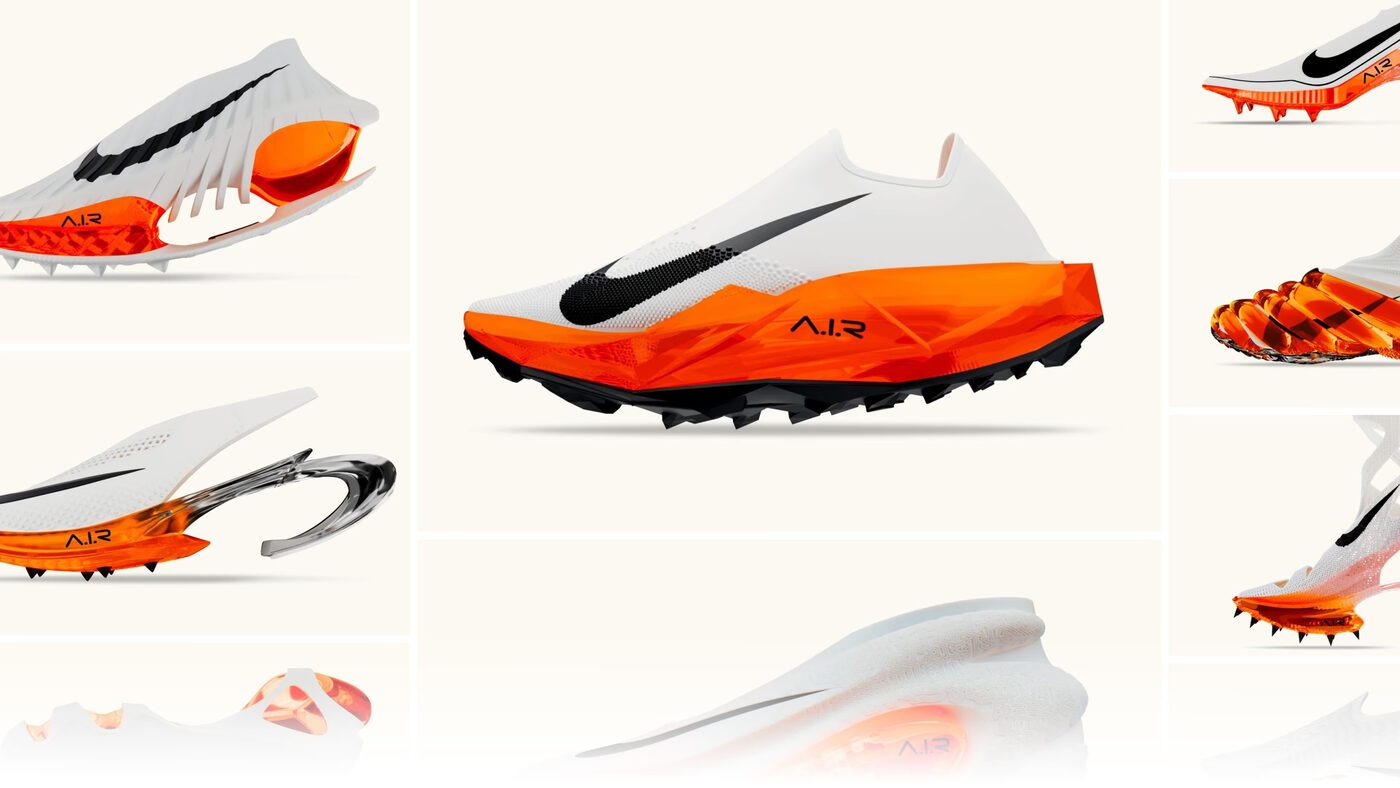
Figure 2.9, Nike A.I.R. (Athlete Imagined Revolution), 3D-printed, AI-assisted concept prototypes presented in Paris, April 2024. (Press image © Nike, Inc., about.nike.com, ‘Creating the Unreal’)
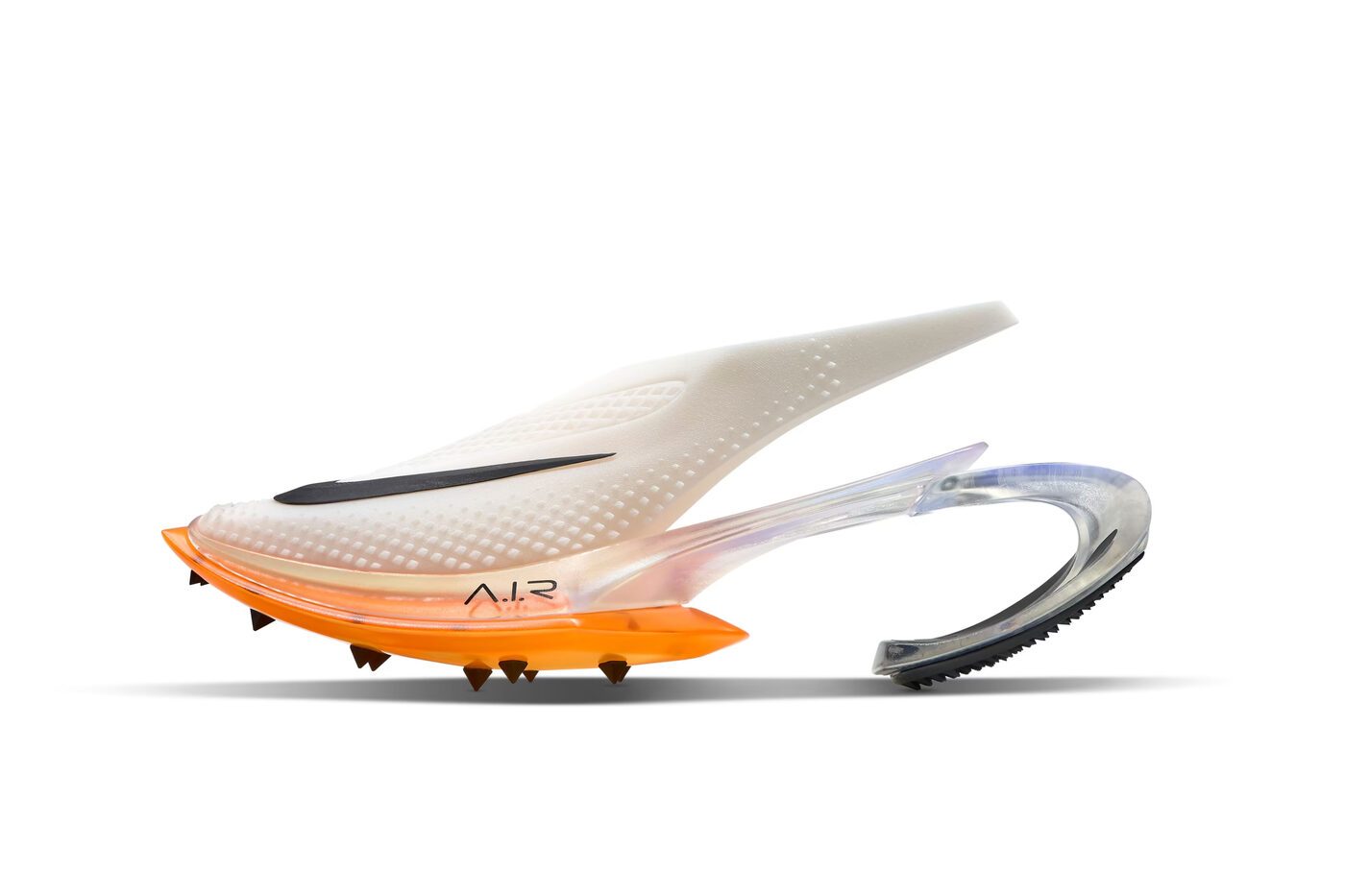
Figure 2.10, Nike A.I.R. prototype for sprinter Dina Asher-Smith: 3D-printed upper with TPU heel clip inspired by a slingback silhouette, persona and performance encoded in one geometry. (Press image © Nike, Inc.)
2.3.5 The AI-Assisted Ideation Workflow
The ideation workflow turns AI from a curiosity into a design method. It runs in four moves:
- Moodboard, collect references, colours, silhouettes and fabric cues that define the direction;
- Text-to-image, translate the moodboard into structured prompts (garment type, silhouette, material, colour, context);
- Image-to-image, feed the strongest result back into the tool and iterate on details such as sleeve length, collar or print placement, while keeping the family resemblance;
- Shortlist, select 3–5 concepts that survive a reality check against construction logic, fabric behaviour and cost.
Prompt engineering for fashion is mostly about describing what the image cannot show: construction (seams, darts, closures), silhouette (fitted, oversized, A-line), material rendering (drape, stiffness, sheen) and print placement (scale, repeat, alignment).
- Do: name the garment, the fit, the fabric and the camera.
- Don't: expect the tool to know pattern logic, grain direction or manufacturing, that is your job; never use an AI image as a tech pack; and always run a feasibility check before a concept moves on.
Try it now
Run three prompt rounds on ONE garment concept:
- Round 1, text-to-image from your moodboard;
- Round 2, image-to-image refinement of the best result;
- Round 3, a variation (colourway, fabric or silhouette).
Shortlist 3–5 concepts. Deliverable: your prompt set plus the shortlist with a one-line rationale each.
- EQF 4: Follow the three rounds using the prompt bank templates.
- EQF 5: Add one material or colourway variation per concept.
- EQF 6: Brief a complete capsule of 3 garments and critique the AI's limitations (construction, fit, manufacturability).
PROMPT BANK, five ready-to-use fashion prompt templates (replace the [brackets]):
- 'Editorial photo of a [garment type] in [colour], [silhouette], on a [body type] model, [setting and lighting], [camera]', concept exploration.
- 'Technical flat of a [garment], front and back, neutral background, [construction details: seams, darts, closures]', technical development.
- 'Close-up of [fabric] with [finish: matte, sheen, texture], drape study on a mannequin', material rendering.
- 'Repeat pattern, [motif], [scale], [colourway], seamless tile, textile print', print development.
- 'Same garment, [new colourway or material], consistent style, studio light', variation series.
← PreviousNext: 2.4 Digital Pattern Making and Zero-Waste Design →