Chapter 2 — full chapter
2.1 2D Digital Drawing and 3D Design
This section follows the designer's toolchain from the first digital sketch to the first 3D model: vector drawings for concepts, technical drawings, and tech packs, and the transition to 3D modeling, where products become precise, testable geometry. Together, they form the foundation on which the computational, AI-based, and zero-waste methods of the following sections are built.
2.1.1 From Pencil to Vector: The Digital Design Toolkit
The work of a fashion designer today combines creative expression with technological competence. Instead of paper and pencil alone, designers use vector-based software such as Adobe Illustrator[8] or the open-source Inkscape[26], as well as professional alternatives such as Affinity Designer[9] and CorelDRAW[14]. Unlike raster graphics, which are made of pixels, vector graphics are based on mathematically defined lines and shapes: a vector drawing can be scaled infinitely without loss of quality, and individual elements can be modified quickly, proportions, colors, materials, details, without redrawing from scratch. In the professional industry, vector graphics serve conceptual sketches, technical drawings and tech packs, print and branding graphics, and presentation materials. A technical drawing shows the product without the human figure but with accurate proportions, front and back views, profile views for complex products, construction notes, and detail 'microviews', and this precision is a sustainability tool: standardized digital communication between designer, construction team, and production reduces errors, misinterpretation, and unnecessary physical prototypes.
Digital drawing also clarifies a distinction every designer must master: the different types of sketches and what each is for. The fashion illustration (figurino) presents the garment on a stylized figure, typically a front three-quarter view, often elongated to nine or ten head heights, and communicates attitude, proportion, color, and fabric behavior; it is evocative by design and metrically unreliable by intention. Study drawings and technical flats do the opposite: the product is drawn without the figure, in absolute orthographic views, front, back, side, and, where necessary, top and bottom, at a consistent scale, so that every view describes the same object unambiguously. Between the two sit exploratory study sketches: quick multi-view drawings used to reason volume, construction, and detail before committing to geometry. In a digital workflow, the three types form a chain, the figurino sets the design intent, multi-view study drawings resolve the form, and the technical flat locks it into the tech pack that production will quote against.
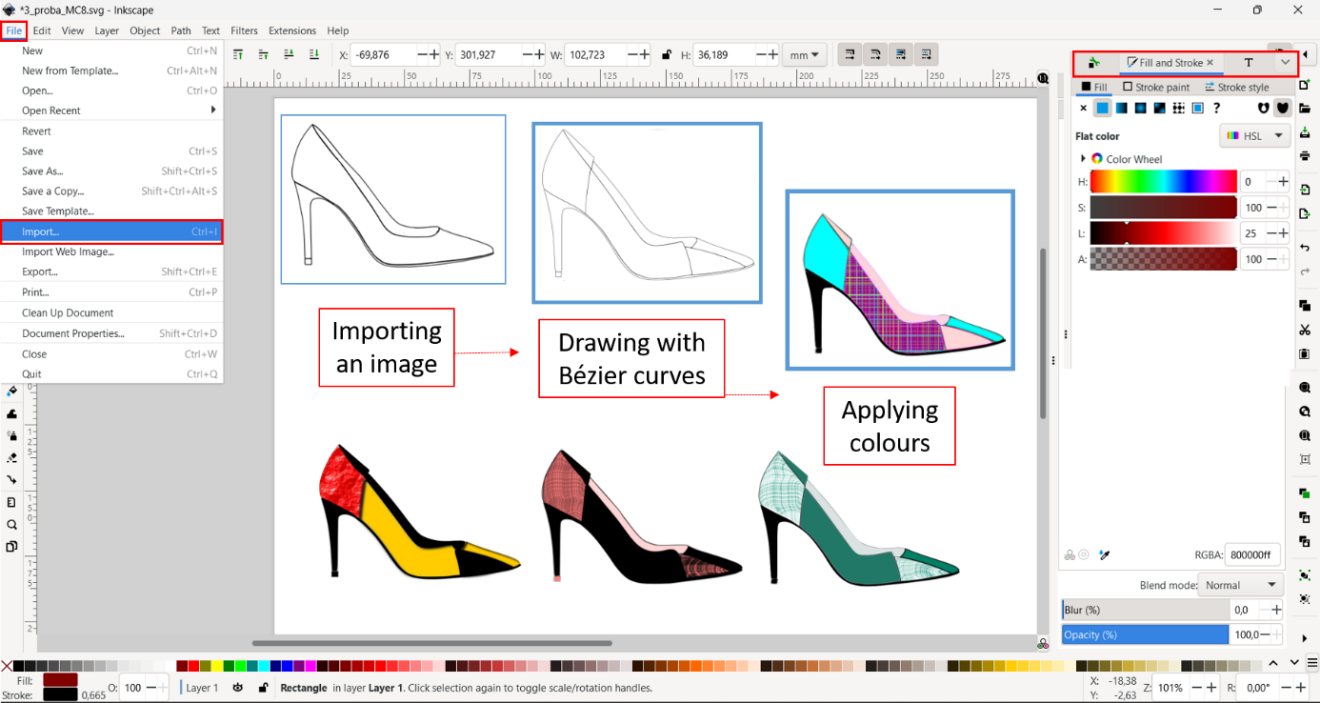
Figure 2.1, Vector workflow in Inkscape: importing a sketch, drawing with Bézier curves, applying colors.
The natural next step is the third dimension. Sketches are digitized, vectorized, and translated into 3D environments, where products are modeled from curves, surfaces, and solids in software such as Rhinoceros [36], using precise units, layers, and reference geometry. In footwear, for example, a sole is modeled against the last, building 2D and 3D curves as guides, generating surfaces through sweep, loft, and patch operations, and refining solids with Boolean and Sub-D techniques. The key insight of 3D design is that geometry encodes function: decisions about thickness, curvature, and transitions determine how forces are distributed, how the product wears over time, and whether it can be manufactured at all, and modeling digitally means anticipating these relationships early, when changing them costs nothing but a file revision.
The 3D landscape itself is not monolithic: modelers differ in how they describe geometry, and the choice has direct consequences for precision, editability, and manufacturability. Surface modelers such as Rhinoceros work with NURBS, mathematically exact curves and surfaces, and excel at the controlled free-form skins of footwear, eyewear, and accessories, where curvature continuity matters. Solid modelers such as Autodesk Fusion[10] or SolidWorks[38] describe products as closed, watertight volumes with a parametric feature history, making them the natural choice for hardware, buckles, heels, molds, and any component that must carry dimensions and tolerances into production. Mesh-based tools such as Blender[11] (or ZBrush[48] for digital sculpting) approximate form with polygon meshes extremely fast for organic exploration, visualization, and animation, but without exact dimensional control, meshes are the language of rendering and 3D printing rather than of engineering. Garment-specific software such as CLO3D[13], Browzwear[12], or Style3D[41] takes a fourth route: the garment is constructed as 2D patterns stitched together and draped on an avatar through physics simulation of the fabric’s mechanical properties, the digital equivalent of the atelier, and the foundation of the virtual prototyping covered in Chapter 3. In practice, these paradigms are combined, and translation between them (e.g. NURBS to mesh for printing) is a one-way, lossy step the designer must plan for.
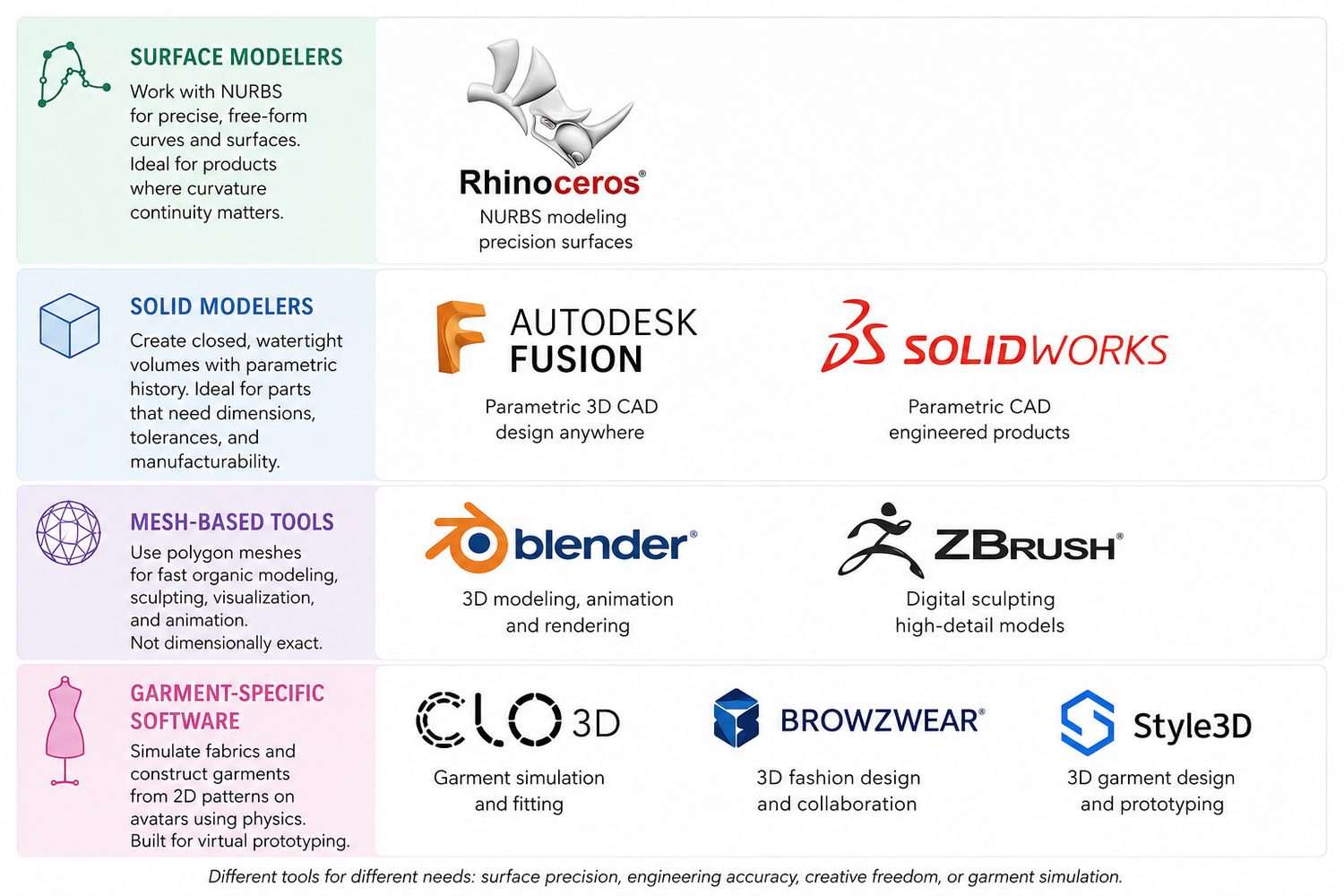
Figure 2.2, Four families of 3D modeling software: surface modelers (NURBS), solid modelers (parametric), mesh-based tools, and garment-specific simulation.
2.1.2 Case example: Tommy Hilfiger / PVH, designing at 100% digital
In 2017, Tommy Hilfiger (PVH Europe) founded the in-house tech incubator STITCH[40] with a declared goal: moving all global design teams at the Amsterdam headquarters to fully digital product creation, reaching 100% 3D apparel design by the Spring 2022 collections. The garment-making design workflow was rethought end-to-end: Digital libraries of fabrics, colors, and patterns replace physical swatches; garments are designed and reviewed as 3D models; and the tech pack, the technical drawing set with construction notes, is generated from the same digital assets, keeping designer, construction team, and suppliers on a single unambiguous reference.
The sustainability results are measurable. For the Fall 2020 season, the men’s dress-shirt category was designed entirely in 3D and required no physical sample production; digital showrooms allowed the company to re-sequence its go-to-market process from sample-led to brand-led selling, cutting sample volumes, courier shipments, and time-to-market. By 2019, associates in more than half of the apparel divisions at headquarters had been trained through the STITCH Academy, with the technology active across more than 20 product groups. The case demonstrates the central claim of this section: a standardized digital drawing-and-modeling chain is not only a creative tool but an infrastructure that removes errors, samples, and waste before anything is produced. (The STITCH incubator has since been discontinued as a separate entity.) (Sources: PVH / Tommy Hilfiger press release, November 2019; Textile World[42]; STITCH case documentation.)
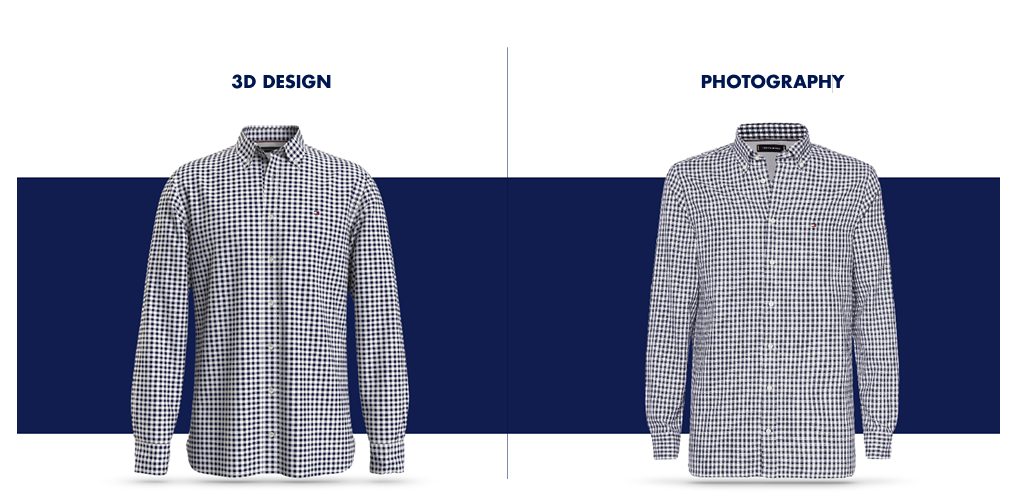
Figure 2.3, Digital twin of a men’s shirt developed within Tommy Hilfiger’s STITCH program: 3D design (left) vs photograph (right). (Source: PVH / STITCH)