Chapter 1 — full chapter
1.4 Case example: Fairly Made, mapping the value chain as a service
Fairly Made[21], a Paris-based traceability and impact platform, demonstrates how the value-chain map in this section serves as an operational tool rather than a diagram. Instead of a single brand publishing its own footprint, Fairly Made digitalizes the chain for many brands at once: it connects each tier, from fiber and spinning through weaving, dyeing, and confection, and structures the resulting data at the product and batch levels, the exact granularity the EU Digital Product Passport will require. On that traceability backbone, the platform runs a life-cycle assessment for every SKU, returning CO₂, water and energy metrics alongside social and recyclability scores, which brands can then surface to consumers as a per-product data statement. By 2025, the service reported more than 100 brands across some 15 countries, over 30,000 connected factories and more than 100,000 LCAs computed on the platform, figures that illustrate how "mapping the value chain from fiber to end-of-life" scales from a conceptual model to shared digital infrastructure (Fairly Made, fairlymade.com; Tech Geography, 2024). The case makes the section's core point concrete: sustainability stops being a claim and becomes a number only when the whole chain is instrumented, and that instrumentation is increasingly bought as a service rather than built in-house.
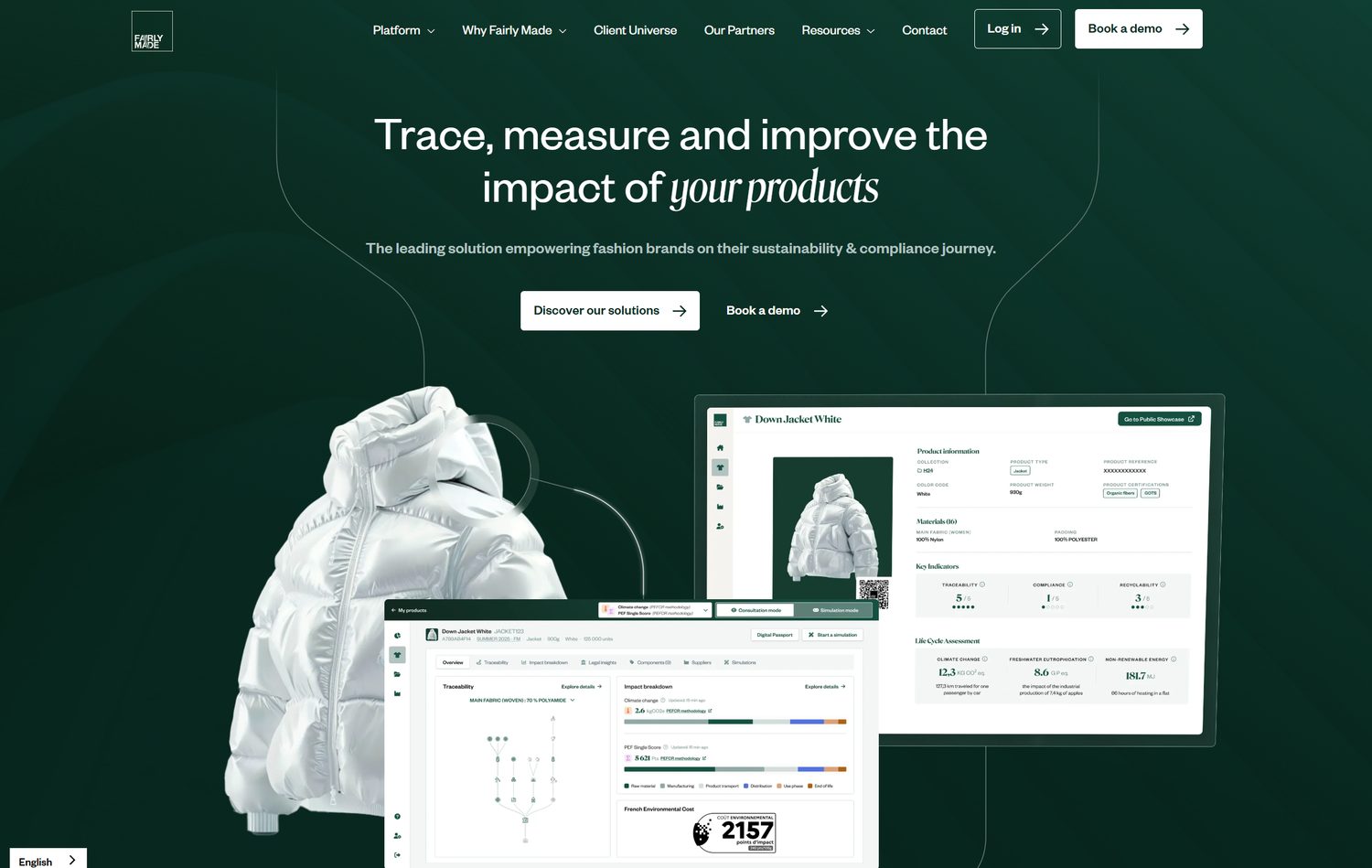
Figure 1.7, Fairly Made's platform links each supply-chain tier to product-level impact data (CO₂, water, recyclability), anticipating the data structure of the EU Digital Product Passport. (Source: fairlymade.com)
TOOLS AND FRAMEWORKS
Policy frame. EU Green Deal; UN Sustainable Development Goals (SDGs); EU Strategy for Sustainable and Circular Textiles (2022).
Product law. Regulation (EU) 2024/1781 (ESPR), which introduces the Digital Product Passport (DPP); Directive (EU) 2024/825 on empowering consumers for the green transition, which restricts generic environmental claims and unverified sustainability labels.
Waste and producer responsibility. Directive 2008/98/EC and its waste hierarchy; Directive (EU) 2018/851, which requires separate collection of textiles; Directive (EU) 2025/1892, which extends Extended Producer Responsibility to textiles; at national level, the French AGEC law and the Refashion eco-modulation shown in Figure 1.6.
Reporting and measurement. CSRD and the ESRS, in particular ESRS E5 on resource use and circular economy; the Product Environmental Footprint method and the PEFCR for Apparel and Footwear v3.1; ISO 14040 and ISO 14044 for life cycle assessment.
Design frameworks. The waste hierarchy read as a design ranking; the 5R framework: Refuse, Reduce, Reuse, Repurpose, Recycle.
Industrial paradigms and enabling technologies. Industry 4.0 and Industry 5.0 (European Commission); IoT, RFID, cloud computing and big data analytics; GS1 identifiers, GTIN and GS1 Digital Link carried by a QR code, which are what make a product record machine-readable rather than declarative.
Voluntary standards an SME can adopt before the obligations arrive. Textile Exchange standards (GRS, RCS, OCS) for recycled and organic content; OEKO-TEX and bluesign for chemical management. None of them satisfies a legal requirement on its own, but each produces the supplier and composition data that the obligations in section 1.3.1 consume.