Chapter 1 — full chapter
1.3 The EU Policy Push: Green Deal, ESPR, Textile Strategy
Regulation is the strongest driver of digitalization in European fashion. This section summarizes the EU policy architecture and translates it into concrete product and data requirements.
POLICY CONTEXT: EU rules for textiles are tightening: the Ecodesign for Sustainable Products Regulation (ESPR) brings the Digital Product Passport, and Directive (EU) 2025/1892 extends Extended Producer Responsibility (EPR) to textiles. Large companies face the first binding dates now (unsold-goods destruction ban from July 2026); SMEs feel the pressure from 2027–2028, as customers and platforms request product data.
The detail is taught withing the other FashionKIC modules: Circular Design Strategies, the Digital Product Passports, the Sustainable Materials and Processes, and the Sustainability Communication and Marketing modules. For this module, policy is context: build the digital workflow now, the data you will need is a by-product of it.
1.3.1 Compliance Arrives on a Schedule: The Order of EU Obligations
Regulation arrives on its own schedule, not on the company's. Section 1.2.2 ordered digital adoption by prerequisite; compliance is ordered by date, and the two sequences do not coincide. For a TCLF SME the obligations nonetheless arrive in a recognizable order, and each of them consumes data produced by the one before it.
The first is already binding on large companies: from 19 July 2026 the ESPR prohibits the destruction of unsold clothing and footwear. Smaller companies are exempt for longer, but the effect reaches them through customers who can no longer treat destruction as a planning safety valve. The second is knowing the product, which means a reliable bill of materials, fiber composition per component, and a supplier list resolved to facility level. No instrument names this as an obligation in its own right, which is why it is the step most often skipped, and yet every subsequent requirement consumes it. The third is publishing a basic product record, typically a QR page carrying composition, origin, care and end-of-life information assembled from data the company already holds. It costs days rather than months, and it is the rehearsal for the passport that follows. The fourth is Extended Producer Responsibility: Directive (EU) 2025/1892 requires Member States to operate functioning textile EPR schemes by April 2028, with fees eco-modulated according to durability, recyclability and design, so that product decisions begin to carry a direct financial signal. The fifth is substantiating environmental claims by a recognized method rather than by self-declaration, for which the PEFCR for Apparel and Footwear v3.1, approved in May 2025, is the reference. The sixth is full conformity with the Digital Product Passport once the ESPR delegated act for textiles applies.
On that last point one distinction is worth holding precisely. The delegated act for textiles is indicatively targeted for adoption in 2027, while application is expected around 2029. Adoption is not application. Planning against the earlier date and budgeting against the later one is the posture that avoids both unpreparedness and premature investment in infrastructure whose requirements are not yet fixed.
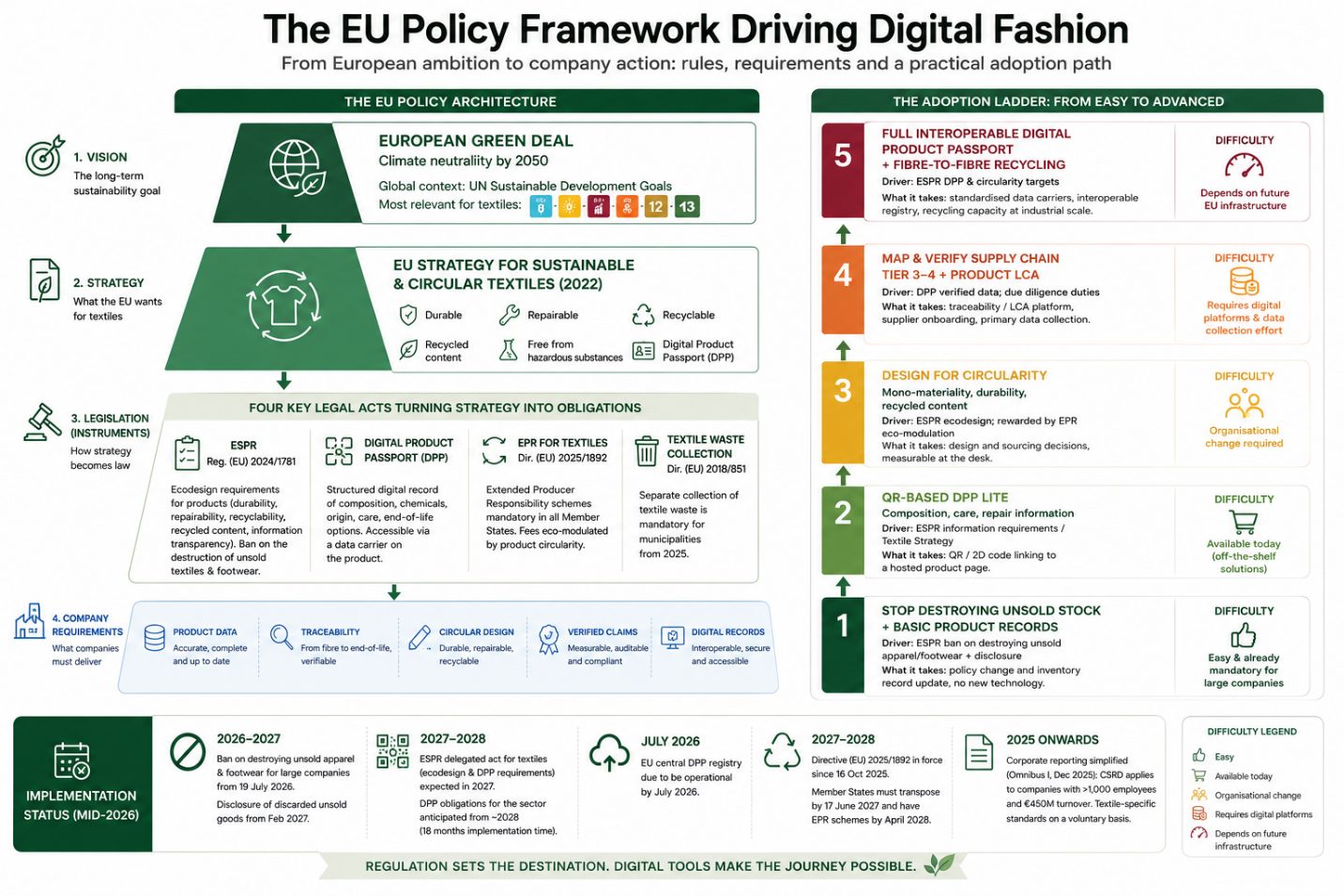
Figure 1.5, The EU policy framework driving digital fashion: from the Green Deal and the Textile Strategy to the ESPR, the Digital Product Passport and EPR, with a practical adoption ladder from easy to advanced.
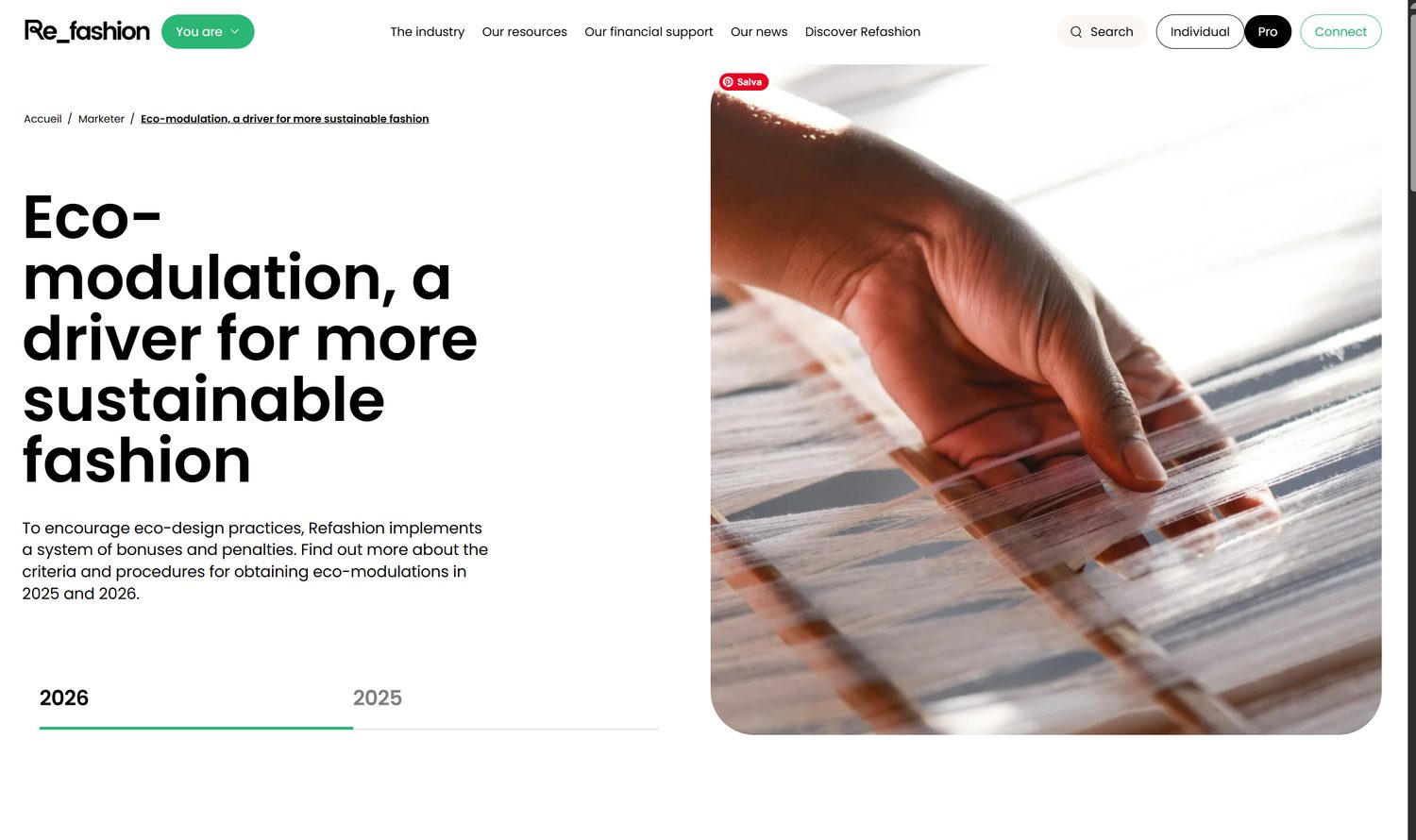
Figure 1.6, Refashion's eco-modulation: bonuses and penalties applied to the eco-fee reward durable, recyclable and eco-designed products. (Source: refashion.fr)