
3.7 Assignment
3.7 Assignment
Choose the track for your profile, then complete the version that matches it. This assignment is worth 5 points; submit your deliverable here (text and/or file upload).
From Circularity Barriers to Circular Innovation Priorities
Learners identify the main circularity challenges affecting a product, organisation or design context, map the stakeholders involved, and prioritise possible responses according to impact, feasibility and available evidence.
Link the activity to the case studies in this chapter: use at least one case (Jeans Redesign, Renewcell/Circulose, Napapijri, Gabriela Hearst × Manos del Uruguay, Resortecs) as evidence when justifying the priorities you propose.
Version A — VET / EQF 4
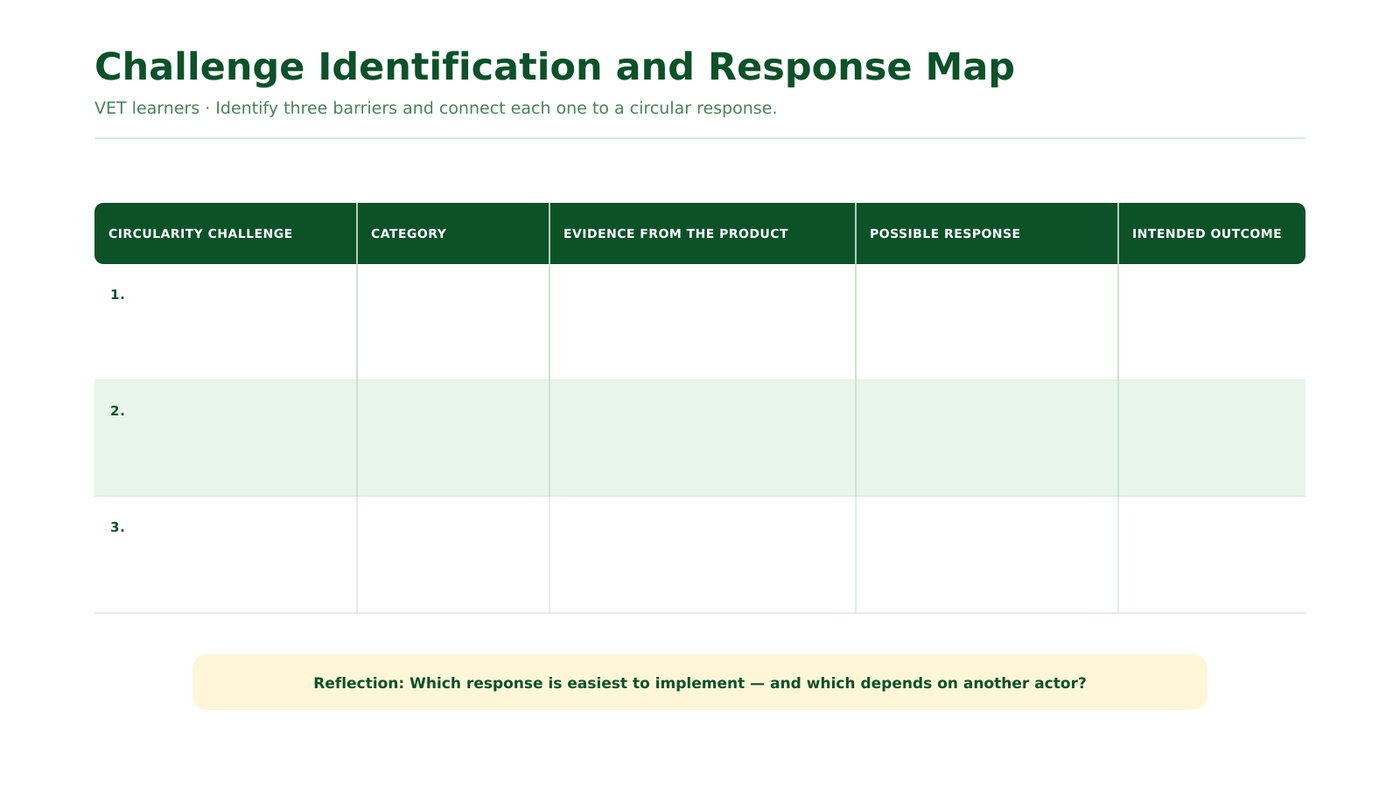
Challenge Identification and Simple Response Map
Duration: 45–60 minutes Format: Individual or pair work Output: Completed challenge-response worksheet + short reflection
Learners select one relatively simple fashion product, such as a T-shirt, hoodie, jeans, jacket, or bag.
They identify three circularity challenges affecting the product and classify each one as:
- material or technical;
- environmental;
- social;
- behavioural;
- supply chain or system related.
For each challenge, they propose one possible design, service, or technical response.
Short reflection
Which response could be implemented most easily, and which would require support from another actor?
Assessment focus: Ability to recognise basic circularity barriers and connect them with relevant responses.
Version B — HEI / EQF 5
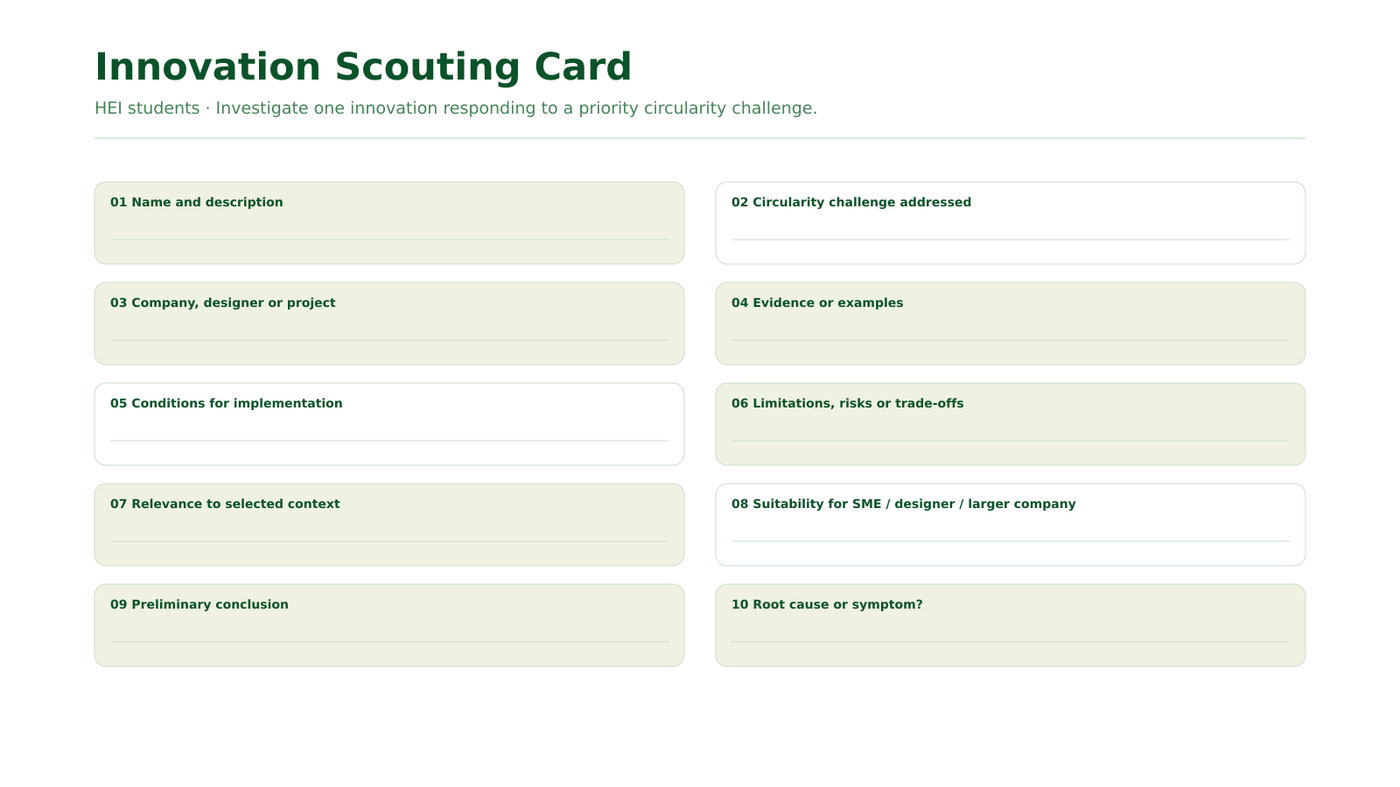
Materiality and Innovation Mapping
Duration: 90–120 minutes Format: Individual or studio work Output: Materiality map + innovation scouting card + critical reflection
Learners select one product, brand, or product category and identify three to five circularity challenges.
They first assess each challenge according to:
- relevance for stakeholders and environmental impact;
- relevance for the product, organisation or value chain;
- urgency;
- capacity to influence the issue.
They then select one priority challenge and investigate an innovation that could respond to it.
Critical reflection
Is the innovation addressing the root cause of the challenge or only one of its symptoms? What additional changes would be required?
Assessment focus: Ability to prioritise challenges, investigate an innovation and evaluate its relevance critically.
Version C — Professionals / SMEs
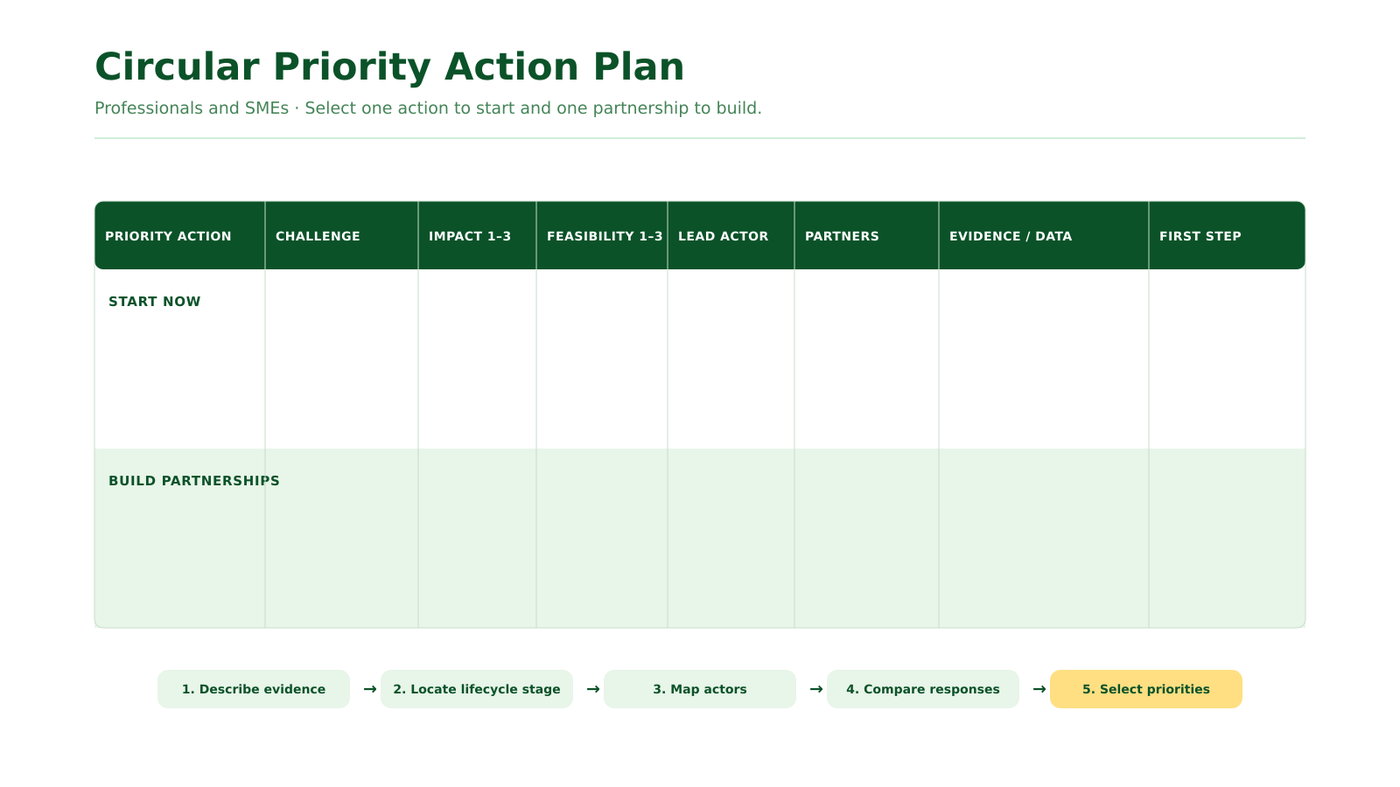
Circular Priority Action Plan
Duration: 2–3 hours Format: Team or company-based workshop Output: Stakeholder map + impact-feasibility matrix + priority action plan
Participants select a real product, product line, or organisational context and identify the three most significant circularity challenges affecting implementation.
For each challenge, they:
- describe the evidence supporting its relevance;
- identify the lifecycle stage where it occurs;
- map the internal and external stakeholders involved;
- identify possible design, service, organisational or technical responses;
- score each response from 1–3 for expected impact;
- score each response from 1–3 for feasibility;
- identify the evidence, resources and partnerships required;
- select one Start now action and one Build partnerships action.
Participants may use B Impact as a broader company-level reference to connect circular product priorities with governance, workers, communities, environmental impact and customers.
Assessment focus: Ability to translate circularity challenges into realistic, prioritised and business-relevant action.
- View
- Make a submission