
Key Takeaways
Key Takeaways
Key Takeaways
- GTIN is GS1’s core identifier and already underpins most product barcodes in Europe as the identification layer for most SMEs already exists.
- GS1 Digital Link turns that identifier into a web address, resolved by a routing layer (a resolver) rather than a single fixed destination.
- A single Digital Link can serve different information to different stakeholders, consumer, regulator, recycler, from one physical code.
- Shared, global identifiers are what make cross-actor interoperability possible without bespoke integrations between every pair of partners.
5.2 QR codes
Where section 5.1 covered the identifier itself, this section covers the most common way that identifier physically reaches a consumer’s phone. The European Commission has identified the QR code as the most common and lowest-cost data carrier available for DPP implementation (Chapter 1, section 1.4.3), which is one reason it is the default starting point for most SMEs rather than a technology decision that needs extensive justification. The Trace4Value pilot introduced in Chapter 3 is a useful proof point at scale: unique digital identities and QR codes were applied to more than 3,000 products across Kappahl and Marimekko, showing that a QR-based passport is not just a small-brand shortcut but a mechanism that holds up across a real, multi-brand product range.
Circular.fashion — Germany. Topic: Digital Product Passport. Circular.fashion is a DPP software provider whose circularity.ID solution issues QR/NFC-based digital product passports and scores circular design, showing how SMEs can issue compliant DPPs without building their own IT infrastructure.
5.2.1 How QR codes work as a consumer-facing data carrier
A QR code is a two-dimensional barcode that a standard smartphone camera can read without a dedicated scanner, which is what makes it a consumer-facing carrier rather than a purely industrial one. When built on the GS1 Digital Link standard described in section 5.1.2, the code carries both the product’s identifier and a resolvable web address in a single image, so scanning it opens a browser page rather than simply displaying a number. For a DPP specifically, this consumer-facing property matters: it is the point at which a shopper, not just a supply-chain actor, gains direct access to the passport.
5.2.2 Placement on the garment and the pathway to DPP data
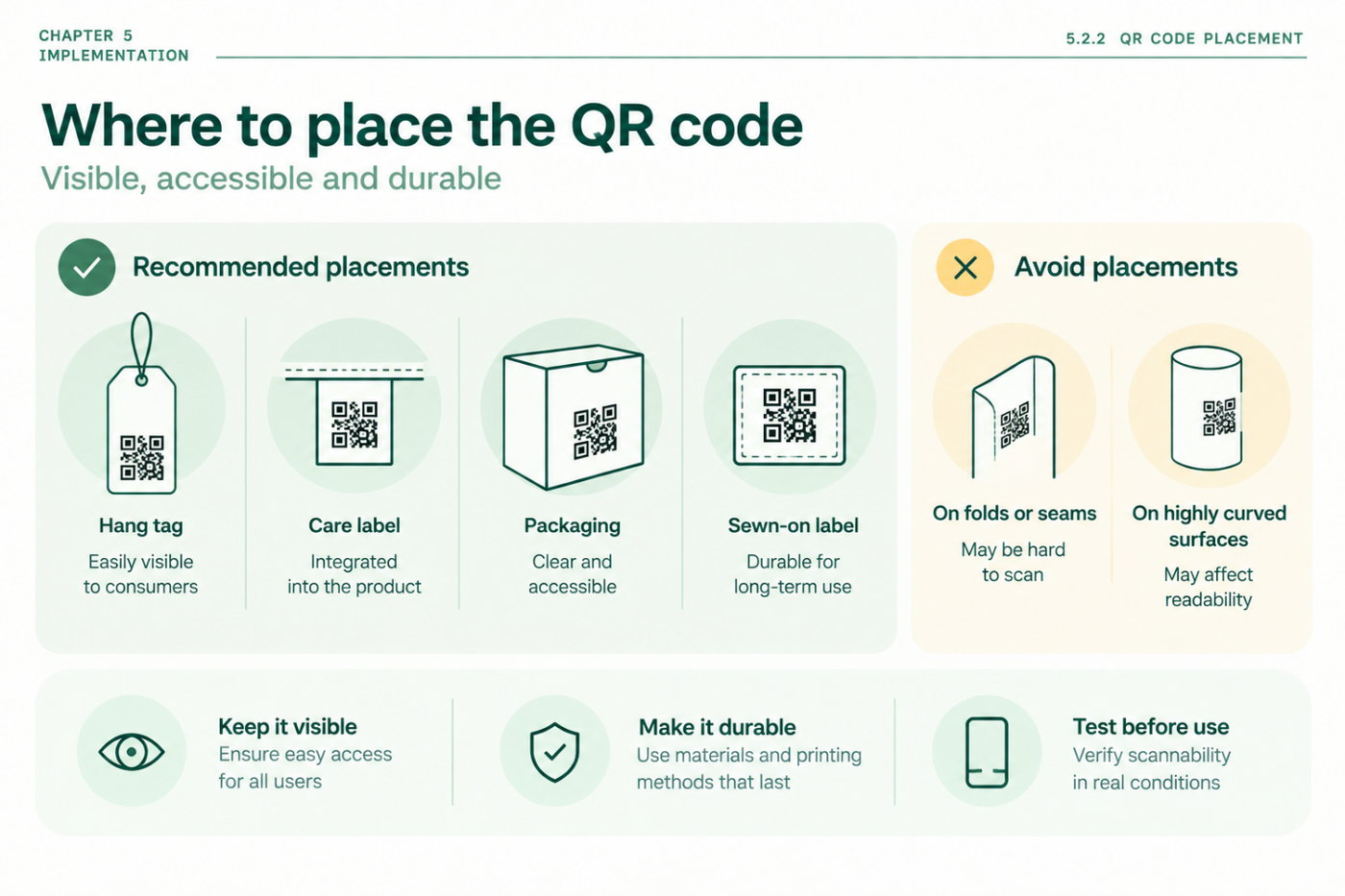
Where a QR code sits on a garment affects whether it is actually used. A code sewn into a care label that gets cut out and discarded, or printed somewhere that fades or abrades quickly, will not survive the product’s life long enough to serve the use-stage and end-of-life data needs. Durable placement on a permanent label, woven or printed to withstand washing is therefore a data-requirements decision as much as a design one: a passport that becomes unreachable after the first wash cycle has failed at exactly the stage where use and repair data was meant to start accumulating.
5.2.3 Cost and practical considerations for SMEs
QR codes require no special reader hardware on the consumer side and relatively low-cost printing or weaving on the production side, which is why they carry the lowest barrier to entry of the carriers covered in this chapter. The main practical costs for an SME are not in the code itself but in what it resolves to: the resolver infrastructure and the underlying data platform. A realistic SME plan treats the QR code as the cheap, easy part of the system and budgets its attention accordingly toward the data behind it.
5.2.4 Case study
For SMEs that would rather not build even this hosting layer themselves, ready-made providers already exist. Circular.fashion, a German DPP software provider, offers a service called circularity.ID that issues QR- and NFC-based passports and scores a product’s circular-design characteristics as part of the same process, letting a brand issue a compliant passport without standing up its own IT infrastructure at all — a concrete example of the “cheap, easy part of the system” logic above, extended one step further into the data layer itself. https://circular.fashion/