
Key Takeaways
Key Takeaways
Key Takeaways
- A data requirement combines the field, its tier (model, batch or item), its verification level, and its update trigger — not just a field name.
- A requirement is not finalised until it is linked to the data carrier that will resolve it to the right record.
- Mandatory and conditional fields set the compliance floor; voluntary fields are where early movers can differentiate.
- Every field needs a named, accountable party — not simply a source it happens to come from.
3.2 Supply chain actors
A Digital Product Passport is only as reliable as the actors who feed it, and a textile value chain typically spans far more organisations than the brand whose name appears on the label.
This creates a structural asymmetry worth naming up front: the actor with the least commercial leverage in the chain, typically a raw-material producer or a deep-tier subcontractor, is often the actor holding the most safety-critical data, while the actor with the most leverage, meaning the brand, usually holds the least of it directly. A DPP data model that does not account for this asymmetry will keep running into the same wall: brands cannot simply mandate better data from suppliers they have limited influence over, so the system has to be designed around distributed, verifiable contribution rather than top-down collection.
3.2.1 Mapping the actors
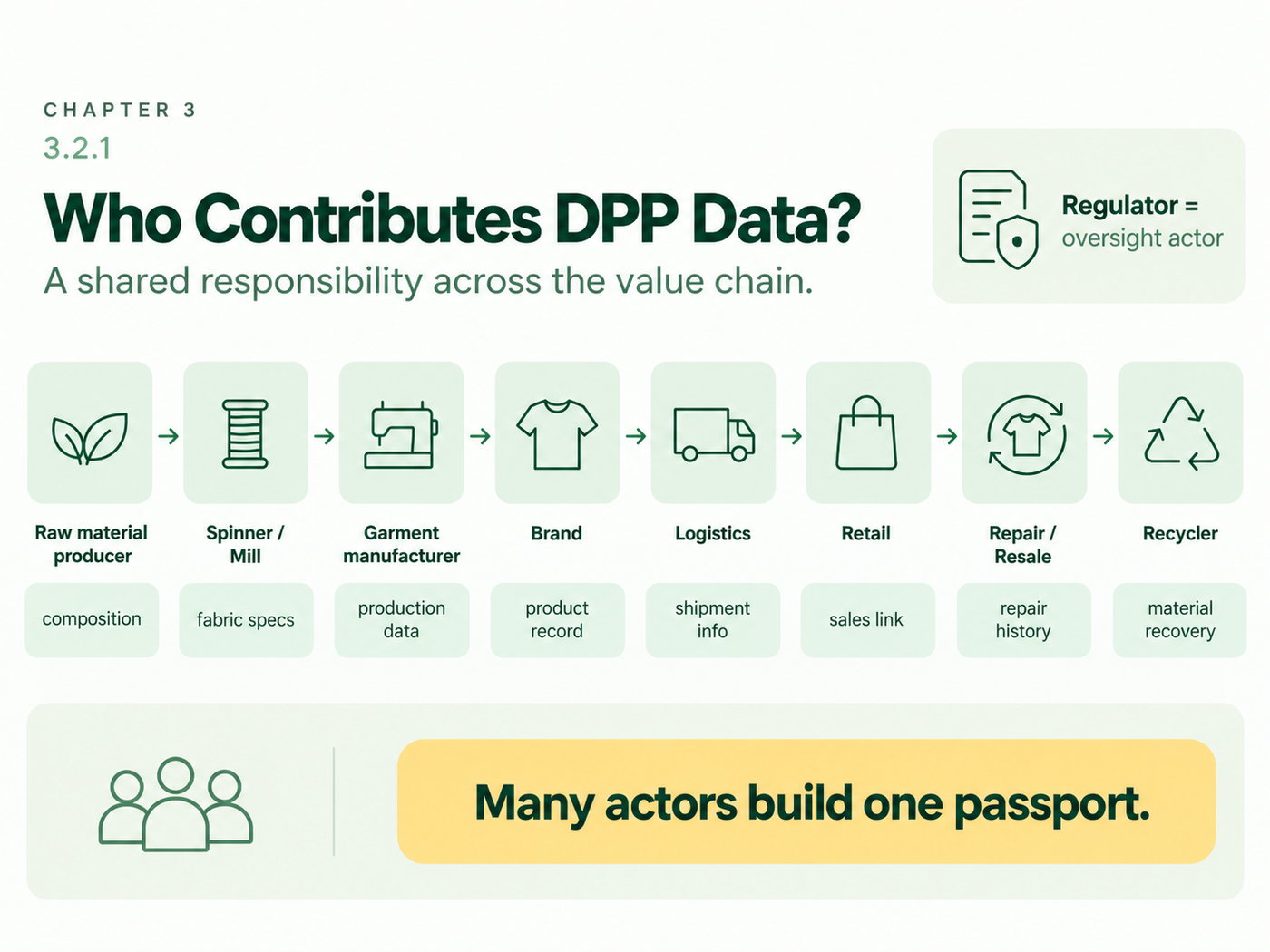
A typical DPP data chain includes raw-material producers, spinners and fabric mills, garment manufacturers (often several tiers deep and outsourced), brands, logistics and distribution partners, retailers, repair and resale services, and recyclers, with regulators as an additional, oversight-only actor. Each actor is both a data source and a data user: a fibre producer supplies composition data it will never itself query again, while a recycler at the very end of the chain depends entirely on data it had no part in creating. Mapping this chain product by product rather than assuming a single generic structure applies to every product line is the necessary first step before any data-collection plan can be realistic.
Textile supply chains typically span five or more countries even for a single garment, so origin traceability has to run the full distance from fibre to finished product, not just back to the nearest supplier. The depth of this chain also varies by material: a cotton t-shirt might involve a ginner, a spinner, a knitter, a dye house and a cut-and-sew factory before it reaches a brand, so five tiers before the label is even attached. A technical outdoor jacket can add several more: a membrane supplier, a coating specialist, a trim and hardware supplier, each contributing data that never touches the brand directly. This is why Chapter 2’s three-tier data model (model, batch, item) and this section’s actor map need to be read together: the tier tells you at what level of granularity a fact was true, while the actor map tells you who was in a position to know it.
3.2.2 Responsibility across the chain
Because responsibility is distributed, the practical question for an SME is rarely “do we have this data” but “who in our chain holds it, and have we ever asked them for it in a structured, repeatable way.” Third-party certification schemes offer a useful model for how distributed responsibility can work in practice. Under the Global Organic Textile Standard (GOTS), for example, every operator in the chain, from the raw-fibre stage through to the final seller, must hold its own current certificate, issued by an independent, accredited certification body, before the finished product can carry the label. Responsibility is verified stage by stage rather than declared once by the brand at the end. A DPP data chain can follow the same logic even without a formal certification scheme attached to it: each actor confirms and timestamps its own segment of the record, rather than a single downstream company trying to reconstruct the whole history after the fact.
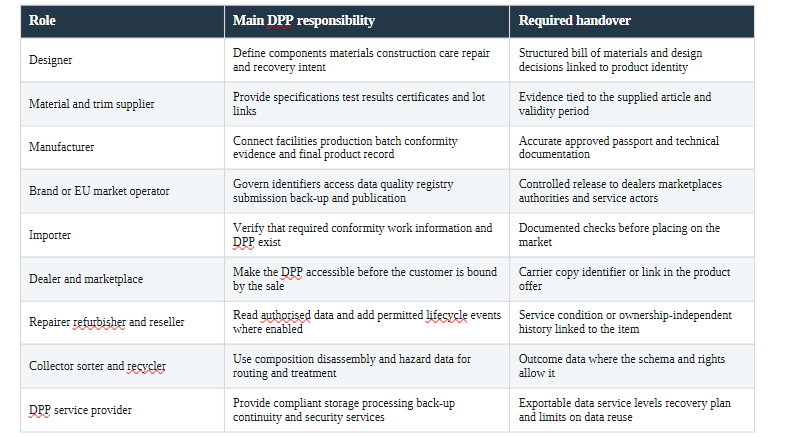
GS1’s EPCIS standard formalises this event-by-event confirmation model at a technical level: rather than one party filling in a static record, each actor logs discrete events that together build up a verifiable history; a batch was produced, a shipment left a facility, an item was received. The certification and the technical standard are solving the same underlying problem from different directions: both replace a single party’s word with a chain of individually accountable, timestamped contributions.
Example
The clearest working example of this actor map in practice is the Trace4Value pilot run by GS1 Sweden together with TrusTrace, Marimekko, Kappahl, and several standards and logistics partners. Selected garments from Kappahl’s and Marimekko’s lines carry a QR code built on GS1 Digital Link: scanning it queries a resolver, which retrieves validated data from more than one storage platform and assembles it into a single consumer-facing record covering materials, suppliers, and circularity information. The pilot’s key output was not the QR code itself but a shared data protocol, meaning an agreed structure and categorisation for the data attributes each actor contributes, which is exactly the kind of actor-by-actor agreement this section argues an SME needs before a passport can work at all.
TrusTrace, the Swedish technology partner behind the pilot, is worth a closer look on its own terms: it operates a supply-chain traceability data platform built specifically to capture and share sustainability and compliance information directly from suppliers, rather than leaving a brand to chase that data down manually, supplier by supplier. For an SME, this is the more replicable part of the story. A shared, purpose-built traceability platform can absorb much of the data-collection burden this section has described, even without running a pilot at Trace4Value’s scale. The project also involved more than the two brands and the technology provider: partners included a facilities-services company, a standards body, a trims and components supplier, and a university research team, each contributing a different slice of the record. For an SME evaluating whether to join or build a similar pilot, the lesson is less about the specific technology chosen and more about the governance work done up front, as the data protocol was, by the project’s own account, as significant an outcome as the consumer-facing passport it produced.
3.2.3 Where data hand-offs break down
The weakest point in almost every traceability chain is the hand-off between actors, not the data held within any single organisation. Common failure points include deeper-tier suppliers who are several steps removed from the brand and have no direct commercial relationship with it, echoing the finding cited in Chapter 4 that data gaps are worst furthest from the brand; language and system incompatibility between partners using different formats, spreadsheets, or platforms; and simple non-response, where a request for data disappears into an inbox with no obligation to reply. Shared, standardised data-collection tools reduce this risk considerably. For an SME, adopting a shared framework rather than building a bespoke one is usually the fastest way to close these gaps.
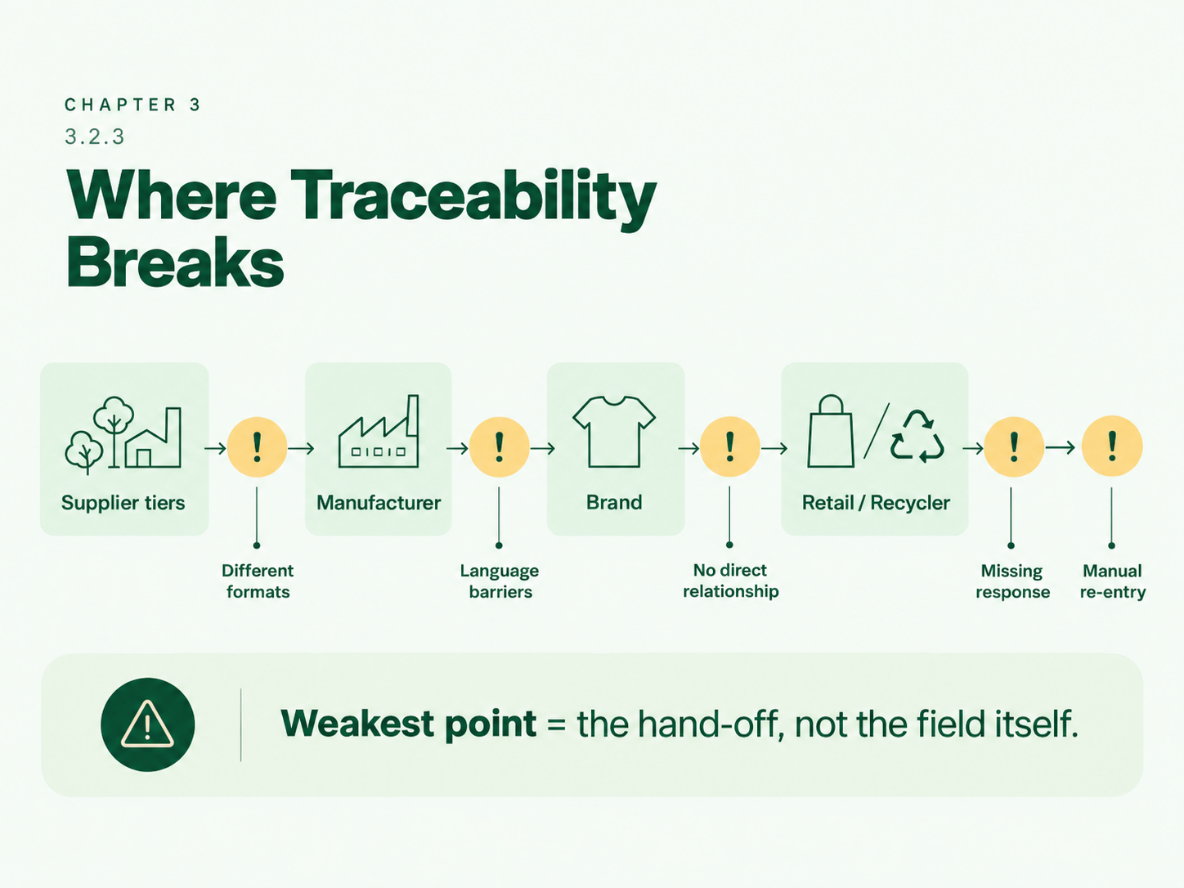
A practical way for an SME to find its own weakest hand-off is to trace one product backward, stage by stage, and note at each step whether the data needed to move forward was received in a usable format, on time, and from a source the business could verify rather than assuming the whole chain is equally strong or equally weak. In most cases the exercise surfaces one or two specific relationships, often several tiers back, that are doing disproportionate damage to the whole chain’s reliability, which is a far more actionable finding than a general sense that “supplier data is hard to get.”
Case Study
TrusTrace, the Swedish platform introduced earlier in this section as the technology partner behind the Trace4Value pilot, is a useful illustration of what closing a hand-off gap actually looks like in practice, rather than in principle. It operates a supply-chain traceability data platform built to capture and share sustainability and compliance data directly across supply-chain actors, fibre composition, certifications, facility information, giving brands and their suppliers a shared, structured way to feed exactly the data fields a DPP requires.
The mechanism matters more than the label. Rather than a brand chasing each supplier individually for a differently formatted spreadsheet, a supplier enters its data once, into a platform built for that purpose, and any brand connected to that platform can draw on it — the same underlying record serving multiple buyer relationships instead of being reconstructed from scratch for each one. For a supplier sitting two or three tiers back from a brand, with limited resources and little reason to prioritise one customer’s bespoke request over another’s, this changes the economics of participation: one structured entry replaces many ad hoc ones. That is precisely the failure mode this section has been describing — language and format mismatches, no direct commercial relationship, requests that go unanswered — addressed not by asking suppliers to do more, but by giving them one place to do it once.
For an SME, the lesson is not that every business needs a platform of this kind before it can close its own hand-off gaps. It is that the shared, standardised tools recommended earlier in this section are not a hypothetical fix: TrusTrace is a working example of one, already operating at the scale of a real, multi-brand pilot, and a reasonable reference point when an SME is deciding whether to build its own supplier-data process from scratch or adopt a platform built to solve exactly this problem.”