
4.8 Assignment — Circular Engagement Journey
4.8 Assignment — Circular Engagement Journey
Choose the track for your profile, then complete the version that matches it.
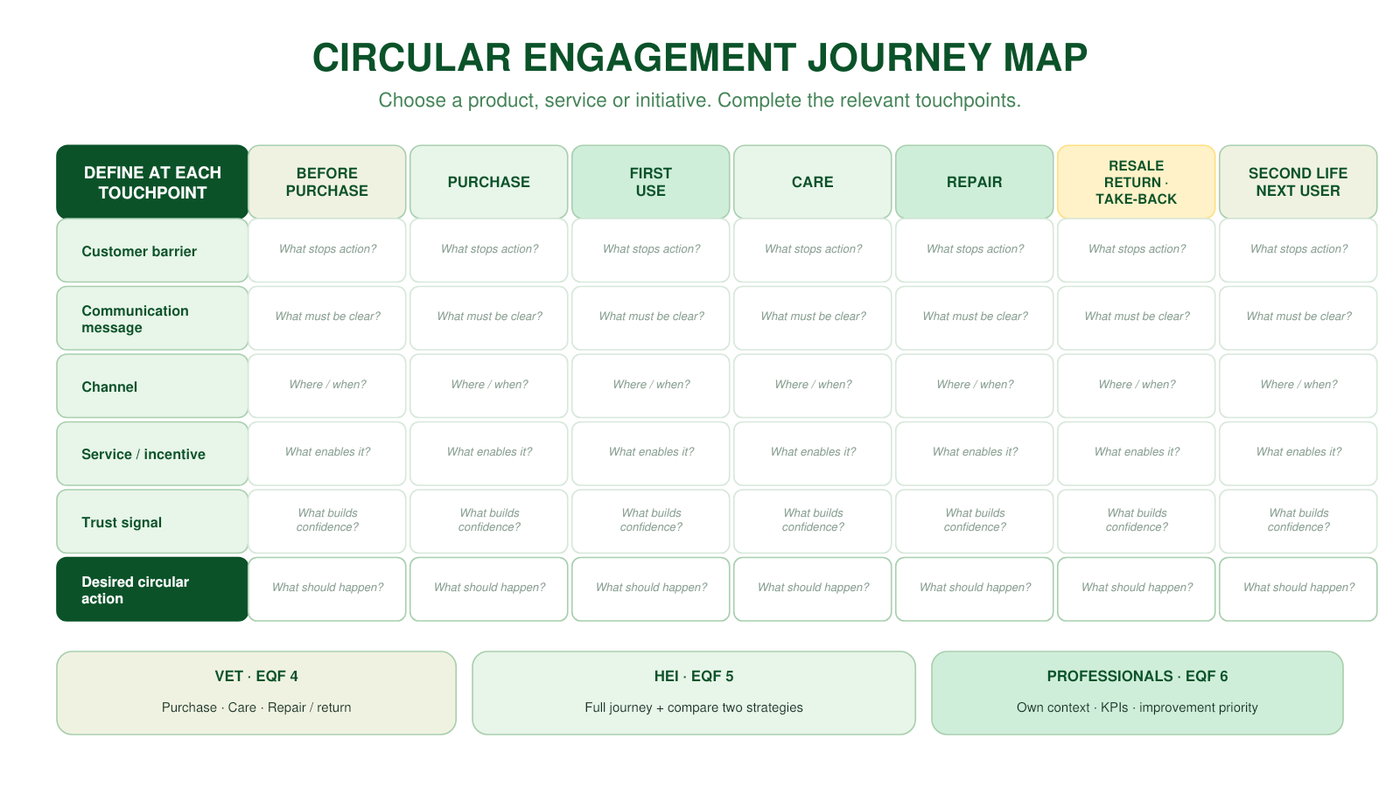
Choose a fashion product, service or circular initiative and map how customers can be supported across its circular engagement journey.
Consider the following stages:
- before purchase;
- purchase;
- first use;
- care;
- repair;
- resale, return or take-back;
- second life or next user.
For each relevant stage, identify:
- the main participation barrier;
- the communication message;
- the most appropriate channel or touchpoint;
- the service or incentive that enables participation;
- the trust signal or evidence required;
- the desired circular action.
Use the Circular Engagement Journey Worksheet to present your analysis. The objective is to connect communication with the practical conditions required for participation. Communication should not be treated as a substitute for an inaccessible or poorly designed service.
For example, if the desired action is repair, explain both how the service should be communicated and what practical information customers need, such as eligibility, access, cost and turnaround time. For take-back, explain what happens to products after return. For resale, identify the information and trust signals needed to reduce uncertainty between users.
Conclude by identifying one stage where improved communication could meaningfully support participation and one barrier that requires a change to the product, service, incentive or wider system.
VET (EQF 4)
Map three stages: purchase, care and repair or return. For each stage, identify one barrier and write one clear customer message. Indicate the channel through which the message should be delivered.
HEI (EQF 5)
Map the complete circular engagement journey. Compare two possible engagement strategies, such as repair versus resale or take-back versus rental. Explain which strategy is more likely to extend product life and why.
Professionals — SME (EQF 6)
Apply the journey to your own brand, organisation or project. Define the barriers, touchpoints, services, incentives, trust signals, and relevant KPIs. Conclude with one priority improvement and explain how it would support both participation and the organisation’s circular objective.
Expected output
A completed journey map showing how communication, service design, accessibility, incentives and trust signals work together before, during and after product use.
- View
- Make a submission